A plain-language look at which symptoms point toward PCOS in teenagers, how they overlap with ordinary puberty, and how to prepare for a doctor's visit.
Published
Quick answer
The most common PCOS symptoms in teens are irregular periods, acne, excess hair growth, hair thinning, fatigue and low mood. Many overlap with normal puberty, so persistent signs or several together are what prompt a doctor's visit, not any single symptom alone.
Key takeaways
- Irregular periods, acne, excess hair growth and fatigue are the most reported PCOS symptoms in teens.
- Many of these overlap with ordinary puberty, so persistence and combination matter more than one sign alone.
- Insulin resistance and androgens are the shared mechanism behind the acne, hair changes and cravings.
- Between 10 and 13% of women worldwide have PCOS, and signs often first appear in the teenage years.
- Tracking symptoms over a few cycles gives a doctor more to work with than a single appointment's memory.
The symptoms of PCOS in teens tend to cluster around three areas: irregular cycles, skin and hair changes driven by androgens, and the fatigue, low mood or cravings that often come with insulin resistance. None of these confirms anything on its own — it's the combination, and how long it lasts, that usually matters.
PCOS affects between 10 and 13% of women worldwide, and for many the first signs appear earlier than any formal diagnosis — often in the teenage years, when they're hardest to tell apart from ordinary puberty. This guide sits alongside insulin resistance and PCOS, which explains the mechanism behind most of what follows.
What are the signs of PCOS in teenagers?
The most commonly reported signs are irregular periods, acne, excess hair growth on the face or body, hair thinning on the scalp, and fatigue, bloating, cramps, cravings, low mood, poor sleep or headaches that show up around the cycle. Several of these together, over several months, are what usually prompts a closer look.
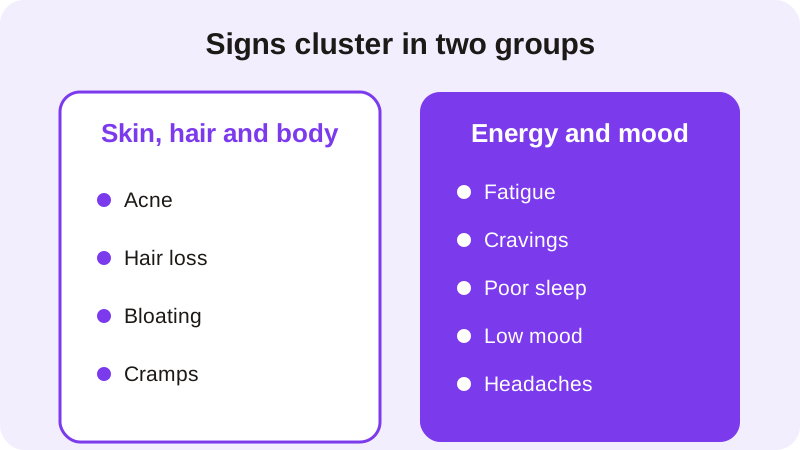
- Skin, hair and body: acne, hair loss, bloating, cramps.
- Energy and mood: fatigue, cravings, poor sleep, low mood, headaches.
Underneath most of these is the same mechanism: insulin resistance pushes the ovaries and adrenal glands to produce more androgens, and androgens are what drive the acne, the hair changes and, for some, the irregular cycles. That chain is explained in more detail in insulin resistance and PCOS, and it is also why the symptoms tend to arrive as a cluster rather than one at a time.
Why cycles run irregular in the first few years after a first period
The signalling between the brain and the ovaries that controls ovulation takes time to settle into a regular rhythm after periods start, which is why cycle length and timing vary so much in the first few years. That variability is normal and expected; it does not, on its own, point to PCOS, and how long it takes to settle varies from one person to another, which is exactly why a doctor is the one who weighs a particular pattern rather than a fixed rule.
Where PCOS comes in is when that settling-in process doesn't resolve, or when irregular cycles arrive alongside acne, hair changes or the fatigue and cravings described above. Insulin resistance can interfere with ovulation directly, which is part of why cycles and skin symptoms so often show up together. PCOS long cycles goes further into why cycles run long and what that looks like month to month, for anyone whose cycles have stayed irregular rather than settling down.
Acne, hair growth and hair thinning: the androgen connection
Androgens are the shared cause behind three changes that often arrive together: acne along the jaw or chest that doesn't respond to the usual teenage skincare routine, extra hair growth on the face, chest or back, and thinning hair at the scalp or hairline. None of these is exclusive to PCOS — ordinary puberty involves rising androgens too — but when they persist for a long stretch, or show up alongside irregular cycles and fatigue, they're part of the same pattern worth describing to a doctor.
Insulin resistance and androgens can also show up on the skin in another way: velvety, darker patches at the neck, underarms or knuckles. PCOS dark patches on skin explains what causes that specific change. On the food side, meals built around protein, fibre and a little fat are the same template that applies to anyone managing insulin resistance, and the PCOS diet guide sets it out without banning any food group — there's no evidence that one diet composition works better than another for PCOS.
Does a teenager need testing, or is it too soon to tell?
There's no single test that confirms PCOS in a teenager from one appointment — a doctor usually looks at the whole pattern of symptoms over time, alongside a physical exam and sometimes blood tests, and decides what fits. Bringing a few months of symptom notes to that appointment matters more than trying to recall everything on the day.
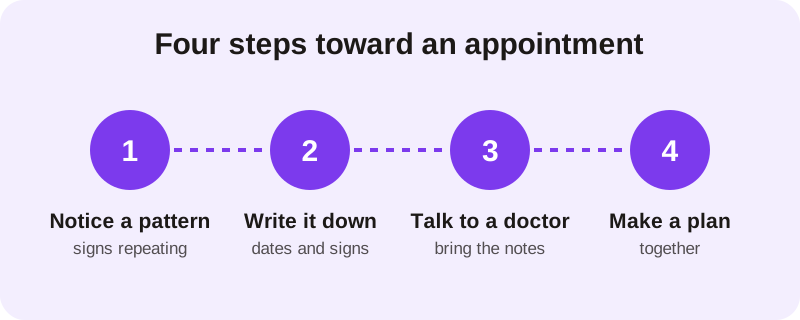
- Notice a pattern — signs repeating over more than one cycle.
- Write it down — dates and which signs showed up.
- Talk to a doctor — bring the notes along.
- Make a plan — together, with tests only if they're needed.
What a doctor does with that pattern depends on what's in it — sometimes it's watchful waiting while the first few years after a first period settle, sometimes it's further tests, and sometimes it's a referral to someone who specialises in adolescent hormones. The point of the notes is to make that decision easier for them, not to arrive with a self-diagnosis.
Keeping track without letting it take over
A simple record works better than an exhaustive one: cycle dates, and which of the recurring signs showed up that day, kept somewhere consistent for a few months. The goal isn't to monitor every possible symptom — it's to have something concrete to compare month to month, instead of relying on a vague sense that "this feels familiar."
The PCOS Pal app is built around that kind of tracking: nine fixed symptoms — fatigue, bloating, cramps, cravings, acne, hair loss, low mood, poor sleep and headache — with no free-text field to fill in, so logging takes seconds, and a doctor summary turns weeks of entries into something quick to hand over at an appointment.
Food doesn't need to change dramatically while all this is being worked out. Meals built around protein, fibre and a little fat are the same approach described in the PCOS diet guide, and it applies whether or not PCOS turns out to be part of the picture — nobody needs to restrict food groups on a hunch.
Sources
Frequently asked questions
Can a teenager have PCOS symptoms without missed periods?
Yes — cycles might still arrive roughly on schedule while acne, excess hair growth, hair thinning or persistent fatigue show up instead. PCOS is diagnosed from a pattern of several signs together, not from periods alone, so it's worth mentioning any combination to a doctor rather than waiting for periods to become irregular too.
Does a teenager need to be overweight to have PCOS symptoms?
No — PCOS and insulin resistance can show up at any body weight, and weight is a lagging indicator rather than a cause. Acne, excess hair growth, cravings or irregular cycles are worth discussing with a doctor regardless of weight, since symptoms and body size don't always track together in PCOS.
Can PCOS symptoms in teens settle down on their own?
Sometimes — cycles often become more regular as the first few years after a first period pass, since that settling-in stretch is normal. But persistent acne, excess hair growth or several signs together don't usually fade by themselves, which is why they're worth raising with a doctor rather than waiting them out.
Is a teenager's acne alone enough to suspect PCOS?
Not usually — acne is extremely common in the teenage years for reasons that have nothing to do with PCOS. It becomes more relevant alongside other signs, such as irregular cycles, excess hair growth, hair thinning or persistent fatigue; a doctor weighs the combination, not one symptom in isolation.
What should a teenager do before seeing a doctor about possible PCOS?
Keep a simple record of cycle dates and whichever signs show up each month — acne, hair changes, fatigue, cravings or mood — for a few cycles. That pattern, brought to the appointment, gives a doctor far more to work with than a single description from memory.
This article is for education. It is not medical advice, diagnosis or treatment — talk to a clinician about your own care.
More in this series
- Anti-inflammatory eating for PCOS: what is real — Where "anti-inflammatory" and PCOS actually meet, which foods the evidence supports, which only marketing does, and how it overlaps with insulin advice.
- Foods to limit with PCOS, and why banning them backfires — The foods worth eating less often with PCOS, the evidence for each, and why "limit" beats "never" for a diet you can keep.
- Insulin resistance and PCOS, explained — What insulin resistance is, why it is so common in PCOS, how it is actually tested, and what food, movement, sleep and medication each do about it.
- Low-GI foods for PCOS: a practical list — What the glycaemic index does and does not tell you, which carbohydrates rank low, how protein and fat change the picture, and where GI stops helping.
- PCOS breakfast ideas that hold you until lunch — Why breakfast is where PCOS eating plans break, the protein-fibre-fat template that fixes it, ten breakfasts that use it, and what to do about coffee.
- PCOS diet: what to eat, and why it works — What the evidence says about eating with PCOS: insulin, the pattern that helps, the foods worth limiting, and why no rigid plan is required.
- PCOS is now PMOS: what changed and what didn't — PCOS has a new name, polyendocrine metabolic ovarian syndrome. Why it changed, and why your diagnosis and treatment stay the same.
- A 7-day PCOS meal plan you can actually keep — Seven days of ordinary meals built on the pattern the evidence supports, with a shopping list and swaps, and no food group cut out.