A practical look at why PCOS cycles run long, what the stretch actually feels like month to month, and how to track a cycle that doesn't follow a fixed rhythm.
Published
Quick answer
PCOS long cycles happen when ovulation runs late or doesn't happen that month, so the whole cycle stretches and bleeding becomes hard to predict by date. Tracking symptoms and signs of ovulation matters more than counting days to a fixed number.
Key takeaways
- A long cycle usually means ovulation was delayed or skipped, not just a one-off late period.
- Insulin resistance can raise androgens, and androgens can disrupt ovulation's normal timing.
- Tracking symptoms and ovulation signs works better than counting toward a fixed cycle length.
- Several long cycles in a row, or heavy or painful bleeding, is worth raising with a doctor.
- No single diet or exercise pattern is proven to shorten PCOS cycles faster than another.
PCOS long cycles are less about one late period than a pattern: the stretch to the next bleed runs past where it usually sits, and some months it doesn't show up at all. Here's what drives that, what it tends to look like month to month, and when it's worth a doctor's input.
What counts as a long cycle with PCOS?
Doctors use a day-count threshold to define a long or irregular cycle, but that's for a clinician to apply to your chart, not something to self-diagnose. What you can watch yourself is the pattern — cycles stretching past your own usual length, bleeding that arrives without warning, or months where the usual signs of ovulation don't show up.
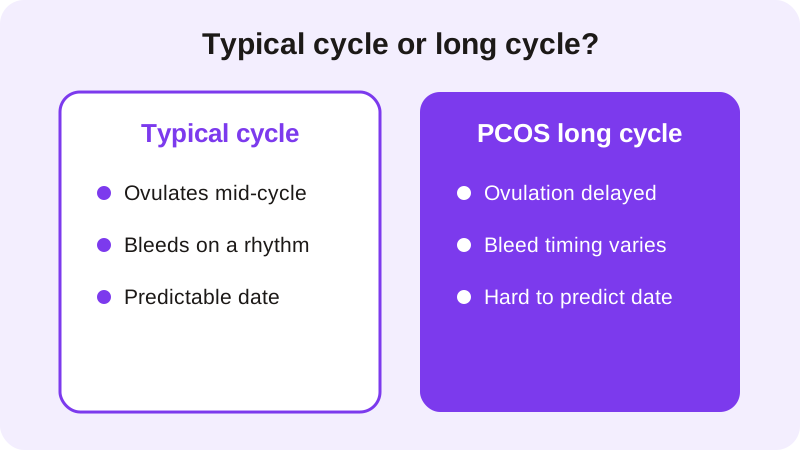
- Typical cycle: ovulates mid-cycle, bleeds on a rhythm, predictable date.
- PCOS long cycle: ovulation delayed, bleed timing varies, hard to predict date.
The signs of ovulation itself — a shift in cervical mucus, a rise in basal temperature — are more useful here than the calendar, especially when the calendar can't be trusted to repeat. Ovulation tracking methods and a BBT chart both work from those signs rather than a day count.
Why PCOS cycles run long
The chain runs through insulin, not the ovaries directly. Insulin resistance means the body needs more insulin than usual to manage blood glucose, and the extra circulating insulin pushes the ovaries to produce more androgens. Androgens interfere with the signalling that normally triggers an egg to release on schedule, so ovulation drifts later, or some months doesn't happen at all, and the whole cycle stretches to match.
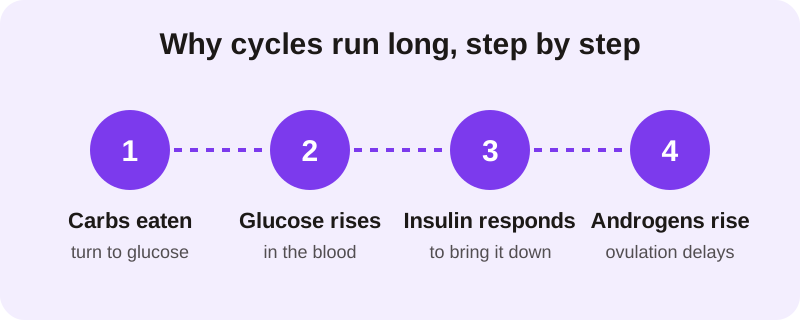
- Carbs eaten turn into glucose during digestion.
- Glucose rises in the blood after the meal.
- Insulin responds to bring glucose back down.
- Androgens rise, and ovulation delays as a result.
The insulin resistance and PCOS page goes through this mechanism in more depth — it's the same chain behind cravings and energy dips, and why meals built around protein, fibre and a little fat tend to help across several symptoms at once, even though the 2023 international guideline is clear that no single diet composition outperforms another for PCOS itself. Over time, the same insulin resistance is also linked to a higher risk of type 2 diabetes, which is one more reason a clinician likes to know the cycle pattern, not just the diet.
What a long cycle actually looks like, day to day
Because ovulation's timing is the thing that moved, the symptoms that usually cluster around it move with it. Fatigue, bloating, cramps, cravings and acne can show up later than expected, or spread out over more weeks than a textbook cycle allows for. Hair loss, low mood, poor sleep and headache often tag along in the same stretch — less because something new started, and more because the hormonal build-up that normally resolves in a couple of weeks is taking longer to peak.
The wait itself can be uncomfortable in its own right: weeks of low-level bloating or cravings with no clear end point is draining before a period even arrives. PCOS bloating and sugar cravings each have their own patterns and are worth reading on their own if either one is the main sticking point in a long stretch.
Tracking a cycle that isn't predictable
A fixed assumption about cycle length is the first thing to drop. Logging the actual start date of each bleed, however far apart, builds your own baseline faster than measuring against someone else's average — and a string of entries is what turns "this feels long" into a pattern a clinician can actually read.
In the app: PCOS Pal logs each cycle as it actually runs rather than assuming a fixed length, tracks nine fixed symptoms including fatigue, bloating, cramps, cravings and acne, and gives a fertile-window estimate rather than claiming to detect ovulation outright. It doesn't log basal body temperature or ovulation tests, so pairing it with a BBT chart fills that gap if pinning down ovulation precisely matters. A doctor summary pulls the logged cycles and symptoms into one view for an appointment.
When long cycles are worth a doctor's visit
See a doctor if cycles have been running long for several months in a row, if bleeding is unusually heavy or prolonged, or if you're trying to conceive and want clarity on ovulation timing — a GP or OB-GYN can check what's driving it and talk through options.
Those options are a clinician's call, not a self-start list. Generic terms like metformin or the combined pill may come up in that conversation, but what fits depends on your history, and a doctor or registered dietitian is the one to weigh that against everything else going on — cycles, symptoms and day-to-day eating included.
A long cycle is information, not a verdict. It's the ovaries describing where ovulation currently sits, not a problem to force back onto someone else's calendar.
Sources
Frequently asked questions
Does a long cycle mean I definitely didn't ovulate?
Not necessarily. Ovulation can still happen in a long cycle, just pushed back from where it would normally sit. Without a way of tracking it — cervical mucus changes or a temperature rise — the length alone can't tell you, which is why watching for signs matters more than counting days.
Can a long PCOS cycle still end with a normal-feeling period?
Yes. Once bleeding starts, flow, cramps and duration can feel completely ordinary even though the lead-up took far longer than usual. What changed is the wait beforehand, not necessarily anything about the bleed itself.
Do long cycles mean I can't get pregnant?
No. Long or irregular cycles mean ovulation is less predictable, not absent every month, so pregnancy is still possible — it just takes more work to pin down the fertile window. A doctor or fertility specialist can talk through options if conceiving is the goal.
Should I change my diet to try to shorten my cycles?
There's no diet composition proven to shorten PCOS cycles faster than another, so the aim is steadier blood sugar generally — meals built around protein, fibre and a little fat — rather than chasing a specific cycle length through food alone.
This article is for education. It is not medical advice, diagnosis or treatment — talk to a clinician about your own care.
More in this series
- Anti-inflammatory eating for PCOS: what is real — Where "anti-inflammatory" and PCOS actually meet, which foods the evidence supports, which only marketing does, and how it overlaps with insulin advice.
- Foods to limit with PCOS, and why banning them backfires — The foods worth eating less often with PCOS, the evidence for each, and why "limit" beats "never" for a diet you can keep.
- Insulin resistance and PCOS, explained — What insulin resistance is, why it is so common in PCOS, how it is actually tested, and what food, movement, sleep and medication each do about it.
- Low-GI foods for PCOS: a practical list — What the glycaemic index does and does not tell you, which carbohydrates rank low, how protein and fat change the picture, and where GI stops helping.
- PCOS breakfast ideas that hold you until lunch — Why breakfast is where PCOS eating plans break, the protein-fibre-fat template that fixes it, ten breakfasts that use it, and what to do about coffee.
- PCOS diet: what to eat, and why it works — What the evidence says about eating with PCOS: insulin, the pattern that helps, the foods worth limiting, and why no rigid plan is required.
- PCOS is now PMOS: what changed and what didn't — PCOS has a new name, polyendocrine metabolic ovarian syndrome. Why it changed, and why your diagnosis and treatment stay the same.
- A 7-day PCOS meal plan you can actually keep — Seven days of ordinary meals built on the pattern the evidence supports, with a shopping list and swaps, and no food group cut out.