A BBT chart rises after ovulation and confirms it happened, but PCOS stretches the wait beforehand, so the chart reads best over several cycles and alongside other signs.
Published
Quick answer
A BBT chart for PCOS shows, after the fact, whether a cycle included ovulation: temperature rises and holds higher once progesterone increases post-ovulation. Because cycle length varies more with PCOS, chart basal body temperature across several cycles rather than judging one month alone.
Key takeaways
- A BBT chart has two phases: lower before ovulation, higher and steady after it.
- With PCOS, the phase before ovulation varies in length, so the rise can land on a different day each cycle.
- A single off reading doesn't mean much — illness, alcohol, travel and poor sleep can all shift it.
- Charting over several cycles, with a thermometer used the same way daily, reads more clearly than one month alone.
- The rise confirms ovulation already happened; it can't predict ovulation in advance.
A BBT chart for PCOS turns your resting temperature, taken first thing each morning, into a record of whether a cycle actually included ovulation. The shift it tracks — a small rise after ovulation — just takes longer to appear and varies more from cycle to cycle with PCOS than without it.
If your cycle has never settled into a predictable length, that's a common experience with PCOS — it affects between 10 and 13% of women worldwide, and irregular ovulation is one of the main reasons why. This page covers what the temperature shift actually shows, why PCOS complicates it, and how to chart it well. It sits alongside the wider guide to tracking ovulation with PCOS, which covers the other methods worth combining it with.
How basal body temperature works
Basal body temperature follows a two-phase pattern across a cycle. Before ovulation, it sits at a lower, fairly flat baseline while an egg is maturing — this is the follicular phase. After ovulation, progesterone rises, and the temperature shifts up to a slightly higher plateau that holds steady for the rest of the cycle. The shift itself is what a basal temperature chart for PCOS is built to catch, not the exact number on the thermometer.
If a pregnancy doesn't happen, progesterone falls, the temperature drops back toward baseline, and a period follows. The rise only ever confirms that ovulation has already taken place — it can't tell you, a day or two beforehand, that it's about to happen.
The shift is small enough that you won't feel it. It shows up only when the same measurement is taken the same way every day and plotted over time, which is why charting matters more than any single morning's reading.
Why PCOS makes the pattern harder to read
With PCOS, it's the stretch before ovulation that varies — the follicular phase can run for an unpredictable number of days before any rise shows up, and in some cycles ovulation doesn't happen at all, so no rise ever appears. The 2023 international guideline names insulin resistance and androgens as part of what disrupts ovulation in PCOS, which is covered in more depth in insulin resistance and PCOS.
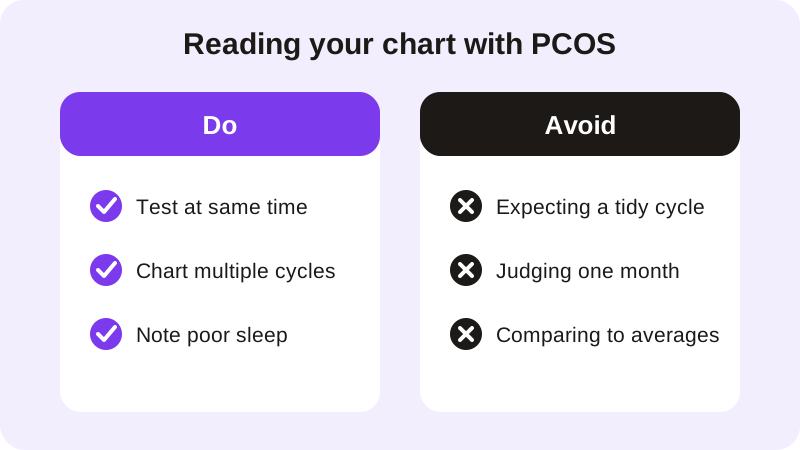
Do
- Test at same time
- Chart multiple cycles
- Note poor sleep
Avoid
- Expecting a tidy cycle
- Judging one month
- Comparing to averages
A chart with no clear rise one month isn't automatically a problem to fix — it may simply mean that cycle didn't include ovulation, which happens more often with PCOS than without it. That's the heart of BBT and PCOS ovulation tracking: the pattern is far more useful read across several cycles than judged from a single one.
How to chart basal body temperature
Building a basal temperature chart for PCOS works the same way whether or not you have PCOS: measure under consistent conditions, log it daily, and watch for the shift over time rather than reacting to any single day's number. The habit matters more than the gadget — a basic basal thermometer and a notebook or app both work, as long as you use the same one every day.
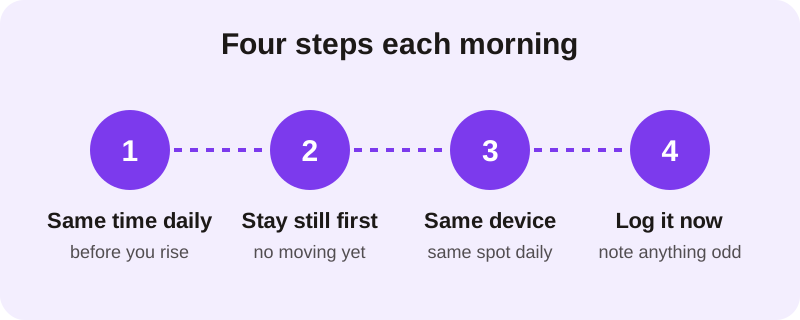
- Same time daily — measure as close to the same time each morning, since temperature drifts overnight and through the day.
- Stay still first — take it before sitting up, talking or reaching for your phone; moving around nudges the reading.
- Same device — used the same way, in the same spot, every day; switching type or method partway through adds noise to the chart.
- Log it now — write the number down immediately, along with anything that might explain an odd reading, like illness, alcohol or a late night.
A thermometer marketed for basal use reads in smaller increments than a standard one, which matters because the shift you're looking for is small. Charting BBT with PCOS means accepting that illness, alcohol, a late night, travel across time zones, or even an unusually cold room can all move a single reading without meaning anything about ovulation — which is exactly why one odd morning shouldn't be over-read, and why the pattern across a full cycle matters more than any one point on it.
Does basal body temperature confirm ovulation with PCOS?
Yes, but only after it happens — the rise appears once progesterone is already circulating, confirming ovulation rather than predicting it. With PCOS, that rise can be delayed, blunted or missing some cycles, so it works best combined with an ovulation predictor kit or cycle-day counting rather than used alone.
The guide to tracking ovulation with PCOS walks through how those methods fit together, including what each one can and can't tell you on its own.
Because the follicular phase is the variable part in PCOS, two cycles can look completely different in length before the rise appears, even in the same person. Reading a BBT chart with PCOS means expecting that — it reflects the same irregular ovulation that makes cycle-day counting unreliable on its own too, rather than a sign that your charting is going wrong.
Where PCOS Pal fits in
The PCOS Pal app doesn't log basal body temperature or ovulation test results. Its cycle tracking works from your logged periods and nine fixed symptoms — including fatigue, bloating, cramps, cravings and acne, plus hair loss, low mood, poor sleep and headache — and from that it gives a fertile-window estimate rather than ovulation detection, built for cycles that don't land on a fixed number of days. If you want to chart basal body temperature too, that still happens alongside the app rather than inside it.
When a chart is worth bringing to a doctor
Bring a few cycles of charting to a doctor if the rise never appears, if your cycles follow no predictable pattern at all, or if you're trying to conceive and want a clearer read on timing. They can combine your chart with your wider history and other tests — blood work, an ultrasound, or a review of your cycle pattern — to work out what's going on and what, if anything, to do next. A dietitian who understands PCOS can also help if food and insulin resistance are part of the picture; the PCOS diet guide is a reasonable starting point for that conversation.
Sources
Frequently asked questions
Can illness or poor sleep change a basal body temperature reading?
Yes. A fever, a late night, travel, alcohol or even a cold bedroom can shift a single morning's reading without any connection to ovulation. That's why one odd day shouldn't be read as a sign either way — look at the pattern across the whole cycle instead, and note anything unusual next to that day's number so you remember why it was different.
Is a special basal thermometer necessary, or will a regular one do?
A basal thermometer reads in smaller increments than most standard ones, which matters because the shift you're tracking is small. Any thermometer used the exact same way, at the exact same time, every single day will show you something — but switching types partway through a cycle makes the chart harder to trust.
How soon after ovulation does basal body temperature usually rise?
It rises once progesterone increases after ovulation, and the rise holds for the rest of the luteal phase rather than appearing gradually. With PCOS, the length of the phase before that rise varies more than it does without PCOS, so the rise can land on a different day of the cycle from one month to the next.
Can a BBT chart diagnose PCOS on its own?
No single chart diagnoses PCOS by itself, and reading too much into one month is a common mistake. A chart can suggest a cycle didn't include ovulation, which is one piece of the picture alongside symptoms and a clinician's assessment of your full history — that conversation belongs with a doctor, not a chart read alone.
This article is for education. It is not medical advice, diagnosis or treatment — talk to a clinician about your own care.
More in this series
- Anti-inflammatory eating for PCOS: what is real — Where "anti-inflammatory" and PCOS actually meet, which foods the evidence supports, which only marketing does, and how it overlaps with insulin advice.
- Foods to limit with PCOS, and why banning them backfires — The foods worth eating less often with PCOS, the evidence for each, and why "limit" beats "never" for a diet you can keep.
- Insulin resistance and PCOS, explained — What insulin resistance is, why it is so common in PCOS, how it is actually tested, and what food, movement, sleep and medication each do about it.
- Low-GI foods for PCOS: a practical list — What the glycaemic index does and does not tell you, which carbohydrates rank low, how protein and fat change the picture, and where GI stops helping.
- PCOS breakfast ideas that hold you until lunch — Why breakfast is where PCOS eating plans break, the protein-fibre-fat template that fixes it, ten breakfasts that use it, and what to do about coffee.
- PCOS diet: what to eat, and why it works — What the evidence says about eating with PCOS: insulin, the pattern that helps, the foods worth limiting, and why no rigid plan is required.
- PCOS is now PMOS: what changed and what didn't — PCOS has a new name, polyendocrine metabolic ovarian syndrome. Why it changed, and why your diagnosis and treatment stay the same.
- A 7-day PCOS meal plan you can actually keep — Seven days of ordinary meals built on the pattern the evidence supports, with a shopping list and swaps, and no food group cut out.