A practical comparison of ovulation tracking methods for PCOS, explaining why irregular cycles make calendar counting and ovulation kits less reliable than logging patterns over time.
Published
Quick answer
Ovulation tracking with PCOS works best as a pattern built from cycle length and symptoms logged over several cycles, not a single test. Basal body temperature and ovulation predictor kits can help, but irregular cycles make both less precise used alone.
Key takeaways
- Calendar counting and ovulation predictor kits assume a regular cycle, which PCOS often doesn't produce.
- Basal body temperature only confirms ovulation after it happens, not before.
- Positive ovulation tests on several days in a row is a known PCOS pattern, not a broken test.
- Logging cycle length and symptoms over several cycles gives a clinician more to work with than one reading.
The home methods for tracking ovulation — counting cycle days, charting basal body temperature, reading an ovulation predictor kit — were built around a cycle that runs on a predictable schedule, and PCOS often doesn't deliver one.
Why PCOS makes ovulation harder to predict
Insulin resistance pushes insulin levels higher, and higher insulin drives the ovaries to produce more androgens; the 2023 international guideline names this hormonal pattern as a core feature of PCOS. The result can be a follicle that doesn't mature and release an egg on the kind of fixed timetable a calendar app expects.
Roughly 1 in 10 women of reproductive age have PCOS, and irregular or absent ovulation is one of the features that often comes with it. That doesn't mean ovulation stops happening — it means it happens less predictably: sometimes earlier or later than expected, sometimes without the clear hormone signal a store-bought test is built to catch, and sometimes not in a given cycle at all. The mechanism behind that is covered in more detail in insulin resistance and PCOS.
What are the ways to track ovulation with PCOS?
The main home methods are counting cycle days on a calendar, charting basal body temperature, reading an ovulation predictor kit, tracking cervical mucus changes, and logging cycle and symptom patterns over time. Each picks up a different signal, and each becomes less precise once cycles stop following a predictable pattern.
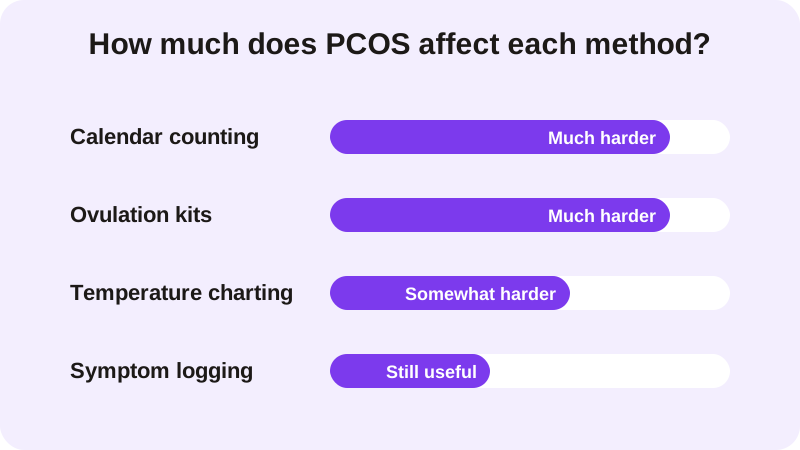
- Calendar counting — much harder
- Ovulation kits — much harder
- Temperature charting — somewhat harder
- Symptom logging — still useful
| Method | What it tracks | How PCOS affects it |
|---|---|---|
| Cycle calendar counting | Days since the last period started | Assumes a consistent cycle length, which irregular cycles don't give you |
| Basal body temperature | A small rise in resting temperature, caused by progesterone after ovulation | Confirms ovulation only after it has already happened |
| Ovulation predictor kits | A surge in luteinizing hormone before ovulation | Can read positive on several days, or not at all, when LH patterns are less clear-cut |
| Cervical mucus tracking | Changes in texture and amount through the cycle | Takes practice to read and can shift with hormonal fluctuation |
| Cycle and symptom logging | Patterns in bleeding and symptoms over months | Works as a record for a clinician even without pinpointing one exact day |
Do ovulation predictor kits work with PCOS?
They can, but less predictably than with regular cycles: PCOS can involve persistently elevated or multiple LH surges, which may trigger positive readings on several days without a true release of an egg, or no clear surge at all. A single test tells you less than results tracked across several cycles.
Basal body temperature has the opposite limitation: it only confirms ovulation after the fact, once progesterone has already caused the small rise it measures. That makes it useful for building a record over time, less useful for predicting ovulation ahead of when it might happen.
Can combining methods make tracking more reliable?
Yes, combining cervical mucus changes, basal body temperature and ovulation test patterns gives a stronger signal than any one method alone, though each sign still depends on a hormonal pattern that's less predictable with PCOS.
The approach is sometimes called a fertility awareness method, and it takes practice to read accurately for anyone, not just with PCOS. If a temperature rise lines up with a mucus change and an earlier positive ovulation test, that alignment counts for more than any single result would on its own.
Every sign in that combination still depends on a hormonal pattern that's harder to pin down when a cycle doesn't run on a predictable schedule, so combining methods improves confidence without guaranteeing a clear answer every month. Logging what you see, even when it's inconsistent, is still useful information for a clinician later.
Common mistakes when tracking ovulation with PCOS
Most of these come from applying a tool built for a textbook cycle to one that doesn't run on that schedule.
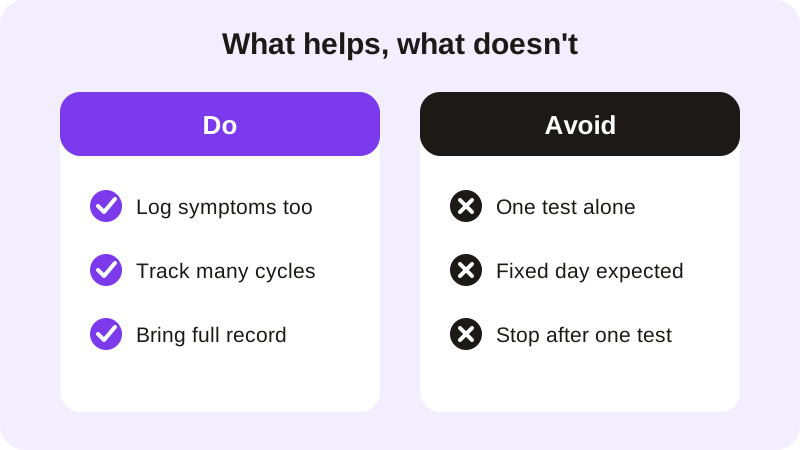
- Do: log symptoms too
- Do: track many cycles
- Do: bring full record
- Avoid: one test alone
- Avoid: fixed day expected
- Avoid: stop after one test
What the PCOS Pal app does — and doesn't do — for ovulation
PCOS Pal gives a fertile-window estimate built from your logged cycles, not ovulation detection, and it doesn't log basal body temperature or ovulation test results, since neither is precise enough on its own to call a result "detected" when cycles are irregular. What it does track is symptoms — fatigue, bloating, cramps, cravings, acne, hair loss, low mood, poor sleep and headache — picked from a fixed list rather than typed in free text, logged against your cycle days so a doctor summary has an actual pattern to show rather than a guess.
When to see a doctor about ovulation or fertility
ACOG includes irregular or absent ovulation as one of the features doctors weigh when considering a PCOS diagnosis, alongside signs of higher androgens and the appearance of the ovaries on ultrasound. Ovulation tracking data is part of what feeds that picture, not a diagnosis on its own.
There's no fixed number of cycles that applies to everyone before it's worth talking to someone, since PCOS cycles vary person to person. What helps is bringing a logged pattern — cycle lengths you've seen, symptoms, any test results — rather than waiting for a single clear-cut sign. If you're trying to conceive and want a clearer read on ovulation than home tracking gives, a doctor or dietitian who knows your history can offer options such as blood tests or further monitoring that aren't available over the counter. The food side of managing PCOS, including the plate-building approach behind the PCOS diet guide, is worth asking about too, since it's one more thing a clinician can tailor to you.
Sources
Frequently asked questions
Can you still ovulate with PCOS even when periods are irregular?
Yes. PCOS can mean ovulation happens less predictably, or is skipped in some cycles, but many cycles still include it, just on a less regular schedule. Tracking symptoms and bleeding patterns over several cycles, rather than expecting a fixed day, is the practical way to see your own pattern.
Does basal body temperature tell you ovulation is coming or that it already happened?
Basal body temperature only confirms ovulation after it has happened, because the small rise it tracks is caused by progesterone released once an egg has already been released. It isn't useful for predicting ovulation ahead of time, which is why it's often paired with another method, like cervical mucus tracking, for a fuller picture.
What does it mean if an ovulation predictor kit is positive for several days in a row?
With PCOS, persistently elevated or fluctuating LH can trigger positive readings on more than one day without a single clear surge. It doesn't necessarily mean the test is faulty — a clinician can help interpret a run of results alongside your broader cycle and symptom tracking.
Is there a specific number of cycles you should track before talking to a doctor?
There's no fixed number that applies to everyone, since PCOS cycles vary person to person; what matters is having enough logged cycles and symptoms to show a clinician a pattern rather than a single data point. If you're concerned sooner, especially if trying to conceive, it's fine to talk to a doctor earlier rather than waiting.
This article is for education. It is not medical advice, diagnosis or treatment — talk to a clinician about your own care.
More in this series
- Anti-inflammatory eating for PCOS: what is real — Where "anti-inflammatory" and PCOS actually meet, which foods the evidence supports, which only marketing does, and how it overlaps with insulin advice.
- Foods to limit with PCOS, and why banning them backfires — The foods worth eating less often with PCOS, the evidence for each, and why "limit" beats "never" for a diet you can keep.
- Insulin resistance and PCOS, explained — What insulin resistance is, why it is so common in PCOS, how it is actually tested, and what food, movement, sleep and medication each do about it.
- Low-GI foods for PCOS: a practical list — What the glycaemic index does and does not tell you, which carbohydrates rank low, how protein and fat change the picture, and where GI stops helping.
- PCOS breakfast ideas that hold you until lunch — Why breakfast is where PCOS eating plans break, the protein-fibre-fat template that fixes it, ten breakfasts that use it, and what to do about coffee.
- PCOS diet: what to eat, and why it works — What the evidence says about eating with PCOS: insulin, the pattern that helps, the foods worth limiting, and why no rigid plan is required.
- PCOS is now PMOS: what changed and what didn't — PCOS has a new name, polyendocrine metabolic ovarian syndrome. Why it changed, and why your diagnosis and treatment stay the same.
- A 7-day PCOS meal plan you can actually keep — Seven days of ordinary meals built on the pattern the evidence supports, with a shopping list and swaps, and no food group cut out.