A plain-language rundown of the nine PCOS symptoms worth tracking, how they relate to cycle patterns, and why a checklist supports but doesn't replace a clinician's diagnosis.
Published
Quick answer
A PCOS symptoms checklist tracks nine recurring signs — fatigue, bloating, cramps, cravings, acne, hair loss, low mood, poor sleep and headache — alongside your cycle pattern, since no single symptom confirms PCOS on its own.
Key takeaways
- Nine symptoms worth tracking: fatigue, bloating, cramps, cravings, acne, hair loss, low mood, poor sleep and headache.
- Cycle length and pattern sit alongside the nine symptoms, not inside the list itself.
- No single symptom confirms PCOS — a clinician reviews the whole pattern plus your history.
- Roughly 1 in 10 women of reproductive age have PCOS, per existing prevalence estimates.
- Logging the same symptoms for a few cycles shows patterns a single day never will.
A useful PCOS symptoms checklist is short and specific: the same nine symptoms, tracked the same way each time, sitting alongside the cycle pattern underneath them. None of the nine confirms a diagnosis by itself — a clinician reads the combination together with your cycle history and whatever examinations or bloodwork they decide to order.
What belongs on a PCOS symptoms checklist?
The nine symptoms worth tracking are fatigue, bloating, cramps, cravings, acne, hair loss, low mood, poor sleep and headache. Logging the same nine each time, rather than writing down whatever you happen to notice that day, is what turns scattered discomfort into a pattern you can actually describe.
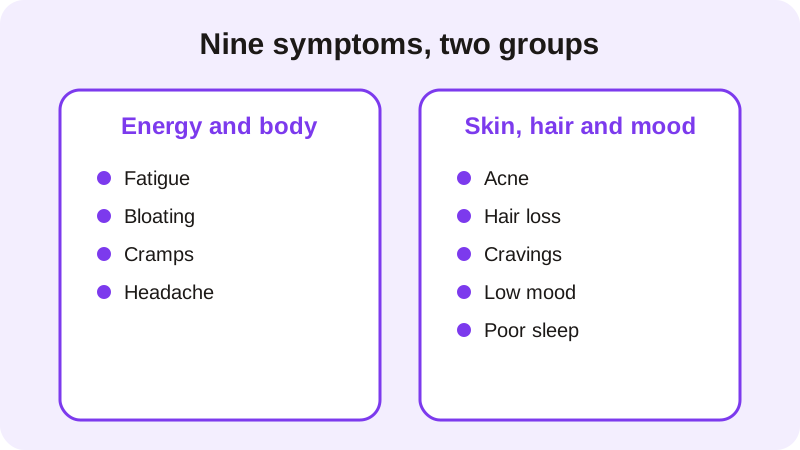
- Energy and body: fatigue, bloating, cramps, headache
- Skin, hair and mood: acne, hair loss, cravings, low mood, poor sleep
The split isn't official — it's just a way to hold nine items in your head. Several of them trace back to the same mechanism: insulin resistance pushes up androgens, and androgens are linked to acne, hair loss and the cravings that follow blood sugar swings. The guide to insulin resistance and PCOS walks through that chain, and the PCOS sugar cravings guide covers why cravings cluster around blood sugar rather than willpower. PCOS affects between 10 and 13% of women worldwide, and roughly 1 in 10 women of reproductive age have it — common enough that having a clear list ready, before you need it, is worth the five minutes it takes to set up.
Where cycle changes fit in
Irregular or long cycles sit next to the nine symptoms rather than inside them, because cycle length is its own pattern worth tracking separately. A cycle that regularly runs long, or skips a month, is itself worth noting alongside whichever of the nine symptoms show up that month — the guide to PCOS long cycles covers what that pattern tends to look like in practice.
Fatigue, low mood and poor sleep are worth watching across a full cycle rather than a single week, because all three can shift with where you are in it. The PCOS and sleep guide and the PCOS anxiety guide both go into why blood sugar and androgens reach into sleep and mood as well as skin and cycles.
Why a checklist isn't a diagnosis
A checklist tells you what recurs and roughly when it recurs. Diagnosis is a separate step a clinician takes, informed by the 2023 international guideline, that weighs your symptoms against your cycle history and whatever examinations or tests they decide are relevant — not a score you tally yourself and compare against a cut-off.
NHS and ACOG both describe PCOS as something worked out from the overall picture a clinician sees, not from a single symptom or a single visit. That's also why a list looks different depending on who's using it. Teenagers are a case in point: cycles are naturally less predictable in the first few years after a first period, which makes timing symptoms harder to read than it is once you have years of cycle history behind you. The guide to spotting PCOS symptoms in teens covers what's typical at that stage.
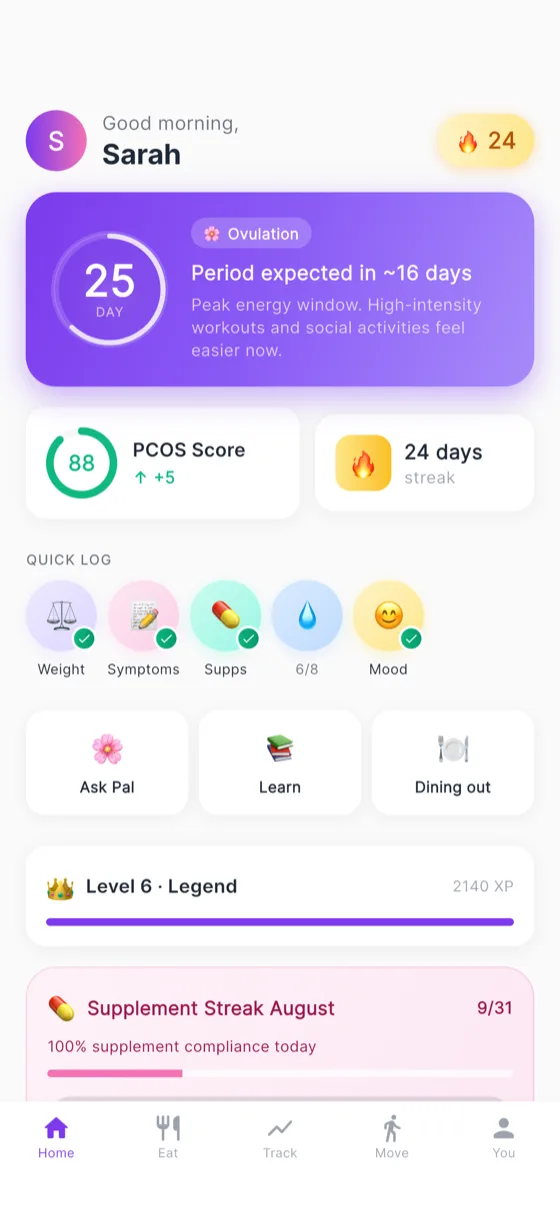
The PCOS Pal app tracks these same nine fixed symptoms, with no free-text field, so entries stay consistent enough to compare week to week, and turns weeks of logging into a doctor summary you can bring to an appointment instead of trying to recall the last two months from memory.
How do you turn a checklist into something useful?
Log the same nine symptoms at a set time each day, note the cycle day alongside them, and review a few weeks at once rather than one day at a time — a single rough day rarely means anything on its own, but a repeated cluster usually does.
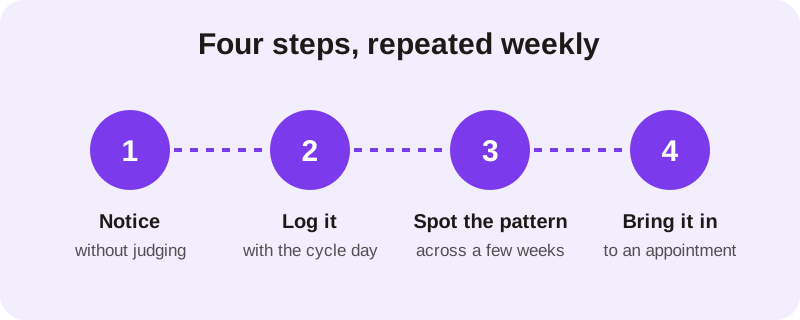
- Notice what you're feeling, without judging it
- Log it against the same nine symptoms and the cycle day
- Look across a few weeks for a repeating pattern
- Bring the pattern to a doctor's appointment
How long a pattern takes to show up varies by person and by how irregular the underlying cycle already is, so there's no fixed number of weeks that works for everyone. Tracking across at least two or three full cycles, however long yours happen to run, usually gives more to work with than a single month does. The guide to tracking PCOS symptoms has a fuller method for building that habit day to day.
Sources
Frequently asked questions
Can you self-diagnose PCOS from a symptoms checklist?
No single checklist confirms PCOS on its own. A clinician looks at your symptom pattern together with your cycle history and whatever examinations or bloodwork they decide to order, so a checklist is a way to prepare for that appointment, not a verdict to settle yourself.
Do PCOS symptoms look the same for everyone?
No — some people notice mostly cycle and skin changes, others mostly fatigue, low mood and cravings. Tracking which of the nine recur for you, and how they move with your cycle, tells you more than comparing your list against anyone else's.
Should a symptom checklist look different for teenagers?
The same nine symptoms are worth watching, but cycles are naturally more irregular in the first few years after a first period, which makes timing harder to read. The guide to spotting PCOS symptoms in teens covers what's typical at that stage.
How long should symptoms take to form a pattern?
It varies by person and by how irregular the underlying cycle already is, so there's no fixed number of weeks that fits everyone. Tracking across at least two or three full cycles, however long yours run, usually gives more to work with than one month does.
This article is for education. It is not medical advice, diagnosis or treatment — talk to a clinician about your own care.
More in this series
- Anti-inflammatory eating for PCOS: what is real — Where "anti-inflammatory" and PCOS actually meet, which foods the evidence supports, which only marketing does, and how it overlaps with insulin advice.
- Foods to limit with PCOS, and why banning them backfires — The foods worth eating less often with PCOS, the evidence for each, and why "limit" beats "never" for a diet you can keep.
- Insulin resistance and PCOS, explained — What insulin resistance is, why it is so common in PCOS, how it is actually tested, and what food, movement, sleep and medication each do about it.
- Low-GI foods for PCOS: a practical list — What the glycaemic index does and does not tell you, which carbohydrates rank low, how protein and fat change the picture, and where GI stops helping.
- PCOS breakfast ideas that hold you until lunch — Why breakfast is where PCOS eating plans break, the protein-fibre-fat template that fixes it, ten breakfasts that use it, and what to do about coffee.
- PCOS diet: what to eat, and why it works — What the evidence says about eating with PCOS: insulin, the pattern that helps, the foods worth limiting, and why no rigid plan is required.
- PCOS is now PMOS: what changed and what didn't — PCOS has a new name, polyendocrine metabolic ovarian syndrome. Why it changed, and why your diagnosis and treatment stay the same.
- A 7-day PCOS meal plan you can actually keep — Seven days of ordinary meals built on the pattern the evidence supports, with a shopping list and swaps, and no food group cut out.