A practical, judgment-free guide to logging PCOS symptoms consistently so patterns across cycles become visible instead of guessed at.
Published
Quick answer
Here's how to track PCOS symptoms: log the same short list of signs every day next to your cycle day, rather than writing free-text notes. Nine common signs — fatigue, bloating, cramps, cravings, acne, hair loss, low mood, poor sleep and headache — are enough to show a pattern over a few cycles.
Key takeaways
- Log the same nine symptoms daily rather than free-text notes, so entries are easy to compare week to week.
- Pair every symptom entry with the cycle day, since PCOS cycles often don't run a fixed length.
- Review by week, not by day — single days are noisy, but a week of entries starts to show a pattern.
- Bring a few cycles of logged data to a doctor's appointment instead of a vague sense that things have been bad.
- Note food alongside symptoms to see how cravings, fatigue or acne connect to what you ate that day.
Tracking PCOS symptoms works best as a short daily habit, not a long diary entry. Here's how to track PCOS symptoms in a way that shows a pattern after a few cycles, instead of a pile of notes nobody reviews.
How do you track PCOS symptoms day to day?
Pick the same short list of symptoms and log it every day, next to the day of your cycle — not a free-text note about how you feel. A fixed, repeatable list is what lets you compare week three against week one.
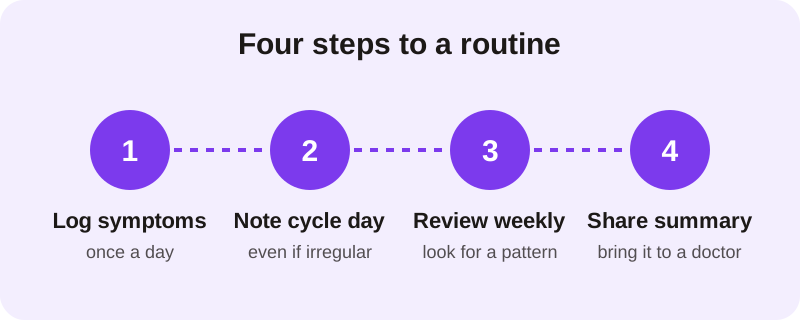
- Log symptoms once a day, using the same short list each time — whichever signs matter to you, kept consistent entry to entry.
- Note cycle day alongside it, counting from the first day of bleeding, even when the gap to the next one is unpredictable.
- Review weekly rather than daily — a single day tells you little, but a week of entries starts to show where symptoms cluster.
- Share summary with a doctor or dietitian, so the pattern you've noticed is part of the conversation rather than a memory you're reconstructing in the room.
A paper notebook does this job fine. So does a spreadsheet. What separates a PCOS symptom diary that gets abandoned after a week from a PCOS symptom tracker you actually keep is whether the fields stay the same every time you open it. The goal is to track PCOS cycle symptoms the same way, day after day, not to write a fuller account each time.
The nine symptoms worth logging
Nine signs come up often enough with PCOS to be worth a fixed spot on any tracker: fatigue, bloating, cramps, cravings, acne, hair loss, low mood, poor sleep and headache.
Keeping that list fixed, rather than writing in whatever word comes to mind, is what makes entries comparable over time. "Tired" one day and "exhausted" the next can look like two different things when they're really the same symptom at two intensities; a fixed scale for fatigue avoids that mismatch.
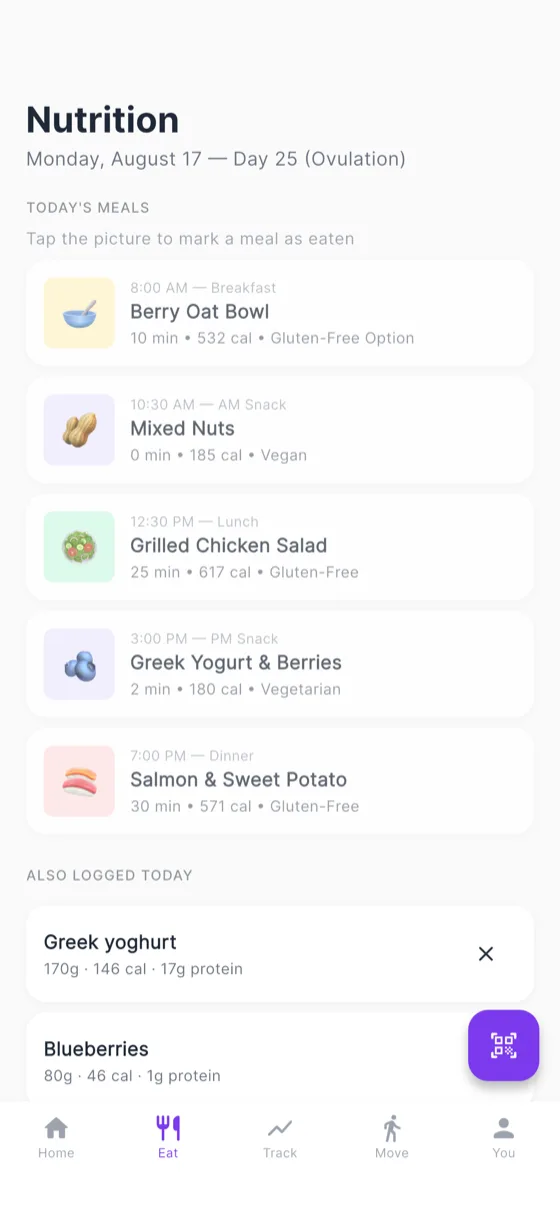
The PCOS Pal app uses this same approach: it logs these nine fixed symptoms against your period dates, with no free-text symptom field, and turns the result into a doctor summary you can hand over at an appointment. Tracking, today's meals and the scanner stay free in the app.
Because PCOS cycles often don't land on a fixed length, the cycle-day field matters as much as the symptom list itself. See PCOS long cycles for what a longer or unpredictable gap tends to look like, and PCOS ovulation tracking methods if you also want to estimate your fertile window alongside your symptoms.
Why does tracking help with insulin resistance and cycle patterns?
Tracking helps because cravings, fatigue and acne aren't random — they often trace back to the same chain: a high-glycaemic meal raises glucose, which raises insulin, which can push androgens higher. Seeing which days a symptom spikes next to what you ate makes that chain visible instead of theoretical.
The 2023 international guideline names insulin resistance as a factor in PCOS and links it to a higher risk of impaired glucose tolerance and type 2 diabetes. Food doesn't cause PCOS, but a meal heavy in fast carbohydrate, eaten without protein or fibre, asks more of an insulin system that's already working harder than it needs to. That mechanism is covered in full in insulin resistance and PCOS.
This is where a symptom log and a food log start to overlap. If cravings or a headache show up a few hours after a particular kind of breakfast, three or four repeats of that pattern are more useful than one bad day. Spotting PCOS symptom patterns like this is the main reason to track at all, rather than just to have a record. The PCOS diet guide explains the protein, fibre and a little fat approach that tends to flatten those swings.
Common mistakes that make tracking less useful
Three habits quietly undo most tracking attempts before they produce anything useful.
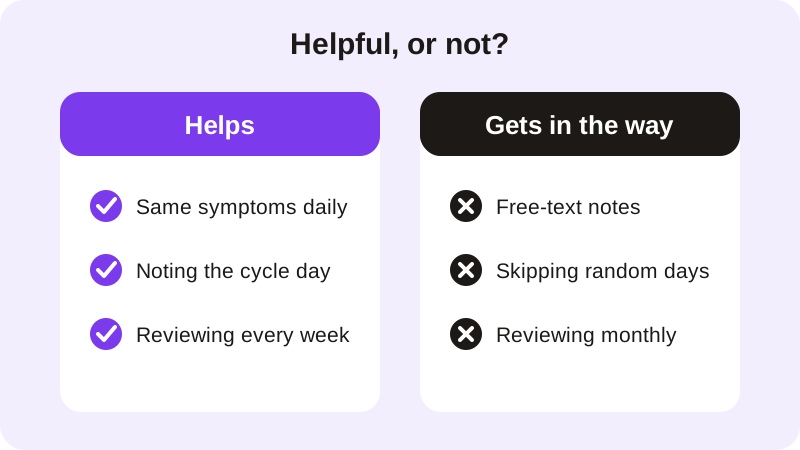
| Helps | Gets in the way |
|---|---|
| Same symptoms daily | Free-text notes |
| Noting the cycle day | Skipping random days |
| Reviewing every week | Reviewing monthly |
Free-text notes feel thorough in the moment and useless three weeks later, because "felt awful" doesn't tell you whether today's awful matches last Tuesday's. Skipping a day here and there breaks the comparison more than it seems to, since the missed days are usually the ones that were worst and least convenient to log. Checking in once a month means relying on memory to fill three weeks of blanks — which is exactly the problem tracking was meant to solve.
None of this needs to be elaborate. A log that takes under a minute a day and gets reviewed once a week will tell you more, after a couple of cycles, than a detailed diary that stops three days in.
Sources
Frequently asked questions
How long should I track symptoms before patterns show up?
It varies, because PCOS cycles don't run a fixed length — some stretch longer than others. Rather than counting days, track across a few full cycles instead of a single week, and treat the review as cycle-based, not calendar-based. If nothing has shifted after several cycles, that's useful information too.
Should ovulation tracking be combined with symptom tracking?
Yes — the two paint a fuller picture together. Methods like counting cycle days, charting basal body temperature or reading an ovulation predictor kit each estimate ovulation differently, and pairing any of them with a symptom log makes it easier to see which symptoms cluster around which part of the cycle.
What should I bring to a doctor's appointment about PCOS symptoms?
A written or printed log covering a few recent cycles works better than a memory of 'it's been bad lately.' Include the symptoms you tracked, roughly when they showed up relative to your cycle day, and any pattern you've noticed — a clinician can use that history to guide what to ask or test next.
Do stress and poor sleep belong in a symptom log?
Yes — low mood and poor sleep are common enough with PCOS to be worth their own line in a log, alongside fatigue and cravings. These tend to move together: a rough night often shows up as low mood or cravings the next day, and a log is one way to notice that link instead of guessing at it.
Does tracking symptoms replace a PCOS diagnosis or treatment plan?
No — tracking is a way to gather information, not a diagnosis. The closest useful next step is bringing what you've logged to a doctor, dietitian or other clinician who knows your history; they can weigh it alongside an exam or tests to decide what, if anything, needs to change.
This article is for education. It is not medical advice, diagnosis or treatment — talk to a clinician about your own care.
More in this series
- Anti-inflammatory eating for PCOS: what is real — Where "anti-inflammatory" and PCOS actually meet, which foods the evidence supports, which only marketing does, and how it overlaps with insulin advice.
- Foods to limit with PCOS, and why banning them backfires — The foods worth eating less often with PCOS, the evidence for each, and why "limit" beats "never" for a diet you can keep.
- Insulin resistance and PCOS, explained — What insulin resistance is, why it is so common in PCOS, how it is actually tested, and what food, movement, sleep and medication each do about it.
- Low-GI foods for PCOS: a practical list — What the glycaemic index does and does not tell you, which carbohydrates rank low, how protein and fat change the picture, and where GI stops helping.
- PCOS breakfast ideas that hold you until lunch — Why breakfast is where PCOS eating plans break, the protein-fibre-fat template that fixes it, ten breakfasts that use it, and what to do about coffee.
- PCOS diet: what to eat, and why it works — What the evidence says about eating with PCOS: insulin, the pattern that helps, the foods worth limiting, and why no rigid plan is required.
- PCOS is now PMOS: what changed and what didn't — PCOS has a new name, polyendocrine metabolic ovarian syndrome. Why it changed, and why your diagnosis and treatment stay the same.
- A 7-day PCOS meal plan you can actually keep — Seven days of ordinary meals built on the pattern the evidence supports, with a shopping list and swaps, and no food group cut out.