A plain-language guide to why period pain feels different with PCOS, what eases it day to day, and when it needs medical attention.
Published
Quick answer
PCOS period pain often follows an anovulatory cycle, so it can feel less predictable than typical cramps. Heat, gentle movement and steadier meals ease it day to day; sudden, severe or one-sided pain needs same-day medical attention.
Key takeaways
- Cramps is one of the nine symptoms often tracked alongside bloating, fatigue, cravings and acne with PCOS.
- Many PCOS cycles are anovulatory, so period pain can arrive without the familiar lead-up of a typical cycle.
- Protein, fibre and a little fat at meals, plus heat and gentle movement, are practical day-to-day options.
- The 2023 international guideline finds no exercise type better than another — gentle movement counts on a cramp day.
- Sudden, severe or one-sided pain, especially with fever, needs same-day medical attention.
Cramping and period pain sit on the same symptom list as bloating, fatigue and cravings with PCOS, but the pattern underneath it often looks different from a standard cycle. Many PCOS cycles don't include ovulation, so the pain that comes with a bleed can arrive on its own timetable rather than a predictable one.
What causes period pain with PCOS?
Period pain comes from prostaglandins, the chemicals that make the uterus contract to shed its lining — not unique to PCOS. What differs is the backdrop: PCOS cycles are often anovulatory, so the wait before a bleed can run long, and the pain that comes with it is less predictable than a textbook cycle.
The insulin resistance that drives PCOS more broadly affects ovulation and cycle timing rather than cramp intensity directly. Cramps, along with bloating, fatigue, cravings and acne, sit on the same list of symptoms often tracked together, because they tend to cluster around the same cycle shifts rather than showing up alone.
How PCOS period pain differs from a typical cycle
A typical cycle delivers cramps in a familiar rhythm: building just before bleeding, peaking early, then fading. PCOS often breaks that rhythm, because a cycle can run long, skip a bleed, or bring spotting rather than a clear one — and the cramping that comes with each of those looks different too.
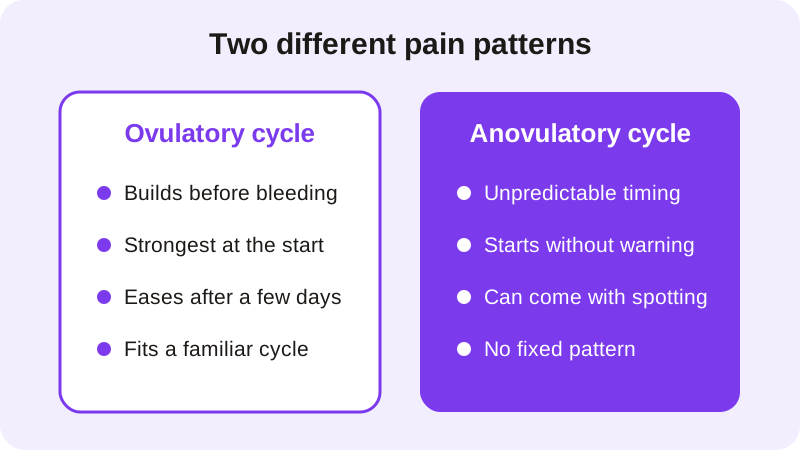
- Ovulatory cycle: builds before bleeding, strongest at the start, eases after a few days, fits a familiar cycle.
- Anovulatory cycle: unpredictable timing, starts without warning, can come with spotting, no fixed pattern.
The long cycles common with PCOS are part of the same picture: a longer wait before a bleed, and sometimes a lighter, spottier bleed instead of a clear one. Cramping often travels with bloating too, which can make the pain feel worse than it is on its own.
What eases period pain day to day
Three things make the most difference day to day: steadier meals built around protein, fibre and a little fat, heat or gentle movement when cramps are active, and keeping up with fluids through the day.
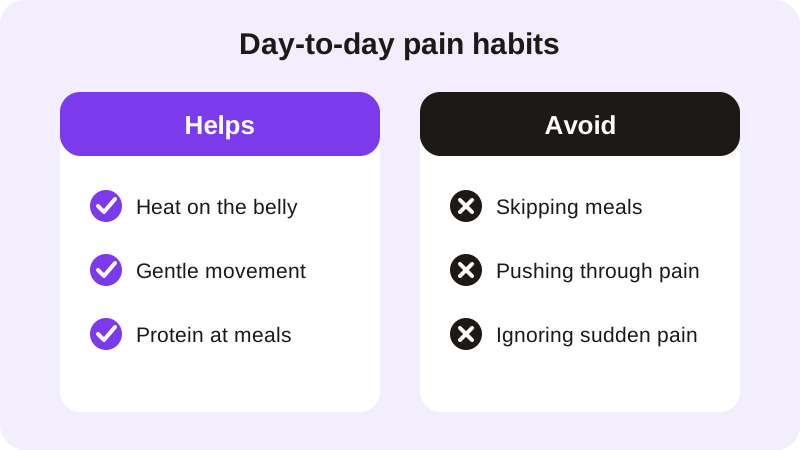
- Helps: heat on the belly, gentle movement, protein at meals.
- Avoid: skipping meals, pushing through pain, ignoring sudden pain.
The PCOS diet guide explains why insulin is the lever with PCOS: food that spikes glucose fast asks for more insulin, and more insulin feeds into androgens. Building meals around protein, fibre and a little fat is the practical version of that, and the same plate works whether the goal is steadier energy or an easier cramp day. The anti-inflammatory eating patterns page goes further into what the evidence actually supports, rather than a list of forbidden foods.
The 2023 international guideline doesn't single out one kind of exercise as better than another for PCOS. It asks for 150 to 300 minutes of moderate activity a week, or 75 to 150 minutes of vigorous activity, plus muscle-strengthening on two non-consecutive days. On a day cramps are bad, gentle movement — walking, stretching, slow yoga — fits inside that range just as well as anything harder. The exercise for PCOS guide breaks the week down further.
Fluids matter too, though there's no PCOS-specific target: the European Food Safety Authority's figure for total water intake is about 2.0 litres a day, and the US National Academies figure is about 2.7 litres. Either range is a reasonable one to aim for, cramps or not.
The PCOS Pal app logs cramps among nine fixed symptoms alongside fatigue, bloating, cravings and acne — plus hair loss, low mood, poor sleep and headache — so a pattern across cycles becomes something you can see rather than something you're guessing at, and a doctor summary turns that log into something worth bringing to an appointment.
When does period pain need a doctor's visit?
See a doctor the same day for pain that is sudden and severe, one-sided, comes with fever, or is paired with heavy bleeding or dizziness — these can signal something other than ordinary cramping. Pain that steadily worsens cycle after cycle, or stops responding to what used to help, is also worth a conversation rather than waiting it out.
A clinician may also talk through options such as the combined pill or another hormonal approach as part of managing a cycle — decided with your history in mind, not a one-size answer — alongside the kind of pain relief you'd use for any period. If cramps are changing shape, getting worse, or showing up with new symptoms, that's the conversation worth having rather than adjusting alone.
Sources
Frequently asked questions
Is PCOS period pain always worse than regular cramps?
It varies — some people with PCOS have mild cramping and others have pain severe enough to disrupt a day, and cycle length variability can make the pattern feel less predictable than a standard cycle. Tracking what a cramp day looks like across a few cycles is the more useful measure than comparing to someone else's experience.
Can the combined pill help with PCOS period pain?
A clinician may consider the combined pill or another hormonal option as part of managing a cycle, but that decision rests on personal history and should be made with a doctor rather than self-started. Pain relief used for any period, plus the day-to-day habits in this guide, works alongside whatever a clinician recommends.
Does PCOS cause cramping without a period arriving?
Yes — because PCOS cycles are often anovulatory, a lining can build and cause cramping before any bleed shows up, or a bleed can be light enough that the cramping is the more noticeable part. If that happens regularly, a doctor can help work out what's driving the pattern.
Can tracking symptoms help spot a pain pattern over time?
Yes — logging cramps alongside the cycle and other symptoms over a few months tends to reveal a pattern that's hard to see in the moment, such as pain clustering around certain cycle lengths or alongside bloating and fatigue. That record is also easier to bring to a doctor's appointment than memory alone.
This article is for education. It is not medical advice, diagnosis or treatment — talk to a clinician about your own care.
More in this series
- Anti-inflammatory eating for PCOS: what is real — Where "anti-inflammatory" and PCOS actually meet, which foods the evidence supports, which only marketing does, and how it overlaps with insulin advice.
- Foods to limit with PCOS, and why banning them backfires — The foods worth eating less often with PCOS, the evidence for each, and why "limit" beats "never" for a diet you can keep.
- Insulin resistance and PCOS, explained — What insulin resistance is, why it is so common in PCOS, how it is actually tested, and what food, movement, sleep and medication each do about it.
- Low-GI foods for PCOS: a practical list — What the glycaemic index does and does not tell you, which carbohydrates rank low, how protein and fat change the picture, and where GI stops helping.
- PCOS breakfast ideas that hold you until lunch — Why breakfast is where PCOS eating plans break, the protein-fibre-fat template that fixes it, ten breakfasts that use it, and what to do about coffee.
- PCOS diet: what to eat, and why it works — What the evidence says about eating with PCOS: insulin, the pattern that helps, the foods worth limiting, and why no rigid plan is required.
- PCOS is now PMOS: what changed and what didn't — PCOS has a new name, polyendocrine metabolic ovarian syndrome. Why it changed, and why your diagnosis and treatment stay the same.
- A 7-day PCOS meal plan you can actually keep — Seven days of ordinary meals built on the pattern the evidence supports, with a shopping list and swaps, and no food group cut out.