A practical weekly exercise template for PCOS — how much, what kind, and how to adjust it around your cycle and energy, rather than a fixed minute count.
Quick answer
There's no single number that answers how much exercise for pcos per week — what matters is a repeatable mix: easy movement most days, strength training a few times a week, and at least one rest day, adjusted to your energy.
Key takeaways
- No fixed number of minutes works for everyone with PCOS — consistency matters more than hitting a target.
- A workable template: easy movement most days, strength training a few times a week, rest built in.
- Strength training gets specific attention because of its link to insulin resistance.
- Matching workouts to your energy across your cycle makes them easier to sustain.
- Constant exhaustion or worsening cycle changes are reasons to scale back and talk to a clinician.
If you're asking how much exercise for PCOS per week is "enough," the honest answer is that no single number fits everyone.
The 2023 international guideline doesn't prescribe one fixed routine for PCOS. It asks for regular activity you'll keep up, with extra attention to strength work because of PCOS's link to insulin resistance. That's the frame for everything below.
How much exercise do you actually need each week?
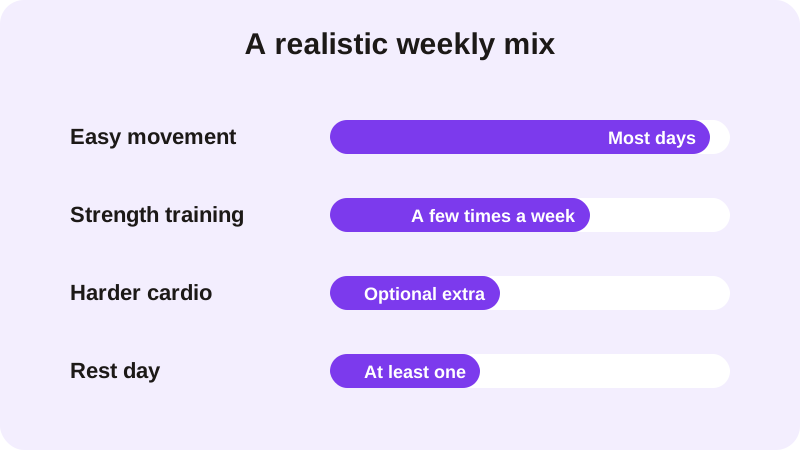
Think in terms of a weekly mix rather than a single tally of minutes. A realistic week has some easy movement on most days, a couple of sessions of strength training, and at least one day that's properly a rest day.
None of this needs a gym. Walking the dog, carrying shopping, gardening, taking the stairs — it all counts as movement, and it adds up over a week in a way a single gym session doesn't replace. What's different with PCOS isn't the general advice, it's the extra reason to make sure strength work has a regular place in the mix, because muscle is where a meaningful share of glucose gets taken up out of the blood. The mechanism is explained in more detail in insulin resistance and PCOS.
There isn't a strict PCOS exercise guideline that sets a precise weekly minute count the way some clinical targets do for other things. Treat the weekly mix above as a starting template, not a quota — something to adjust to your schedule, your joints, and how your week actually goes, rather than a box to tick.
Does the type of exercise matter more than the amount?
Not dramatically — but strength training for PCOS deserves a specific mention, separate from the general "move more" advice.
When insulin resistance is part of the picture, muscle that's used regularly responds better to the insulin already circulating. That's part of why strength work is usually added alongside cardio rather than used instead of it. The cardio vs strength PCOS question isn't really either/or — walking and other easy cardio keep you moving day to day, while strength sessions build the muscle that does some of the metabolic work.
| Type | Main benefit | How often |
|---|---|---|
| Walking or easy cardio | Keeps you moving without added strain | Most days |
| Strength training | Builds muscle that uses glucose | A few times a week |
| Harder cardio | Raises fitness and heart health | Optional, when energy allows |
| Rest or gentle stretching | Lets the body recover | At least one day |
None of this means one approach beats another in a strict sense. A week built entirely of walking is still better than a week of nothing. A week with no strength work at all is still worth doing. The template is a direction to lean in, not a pass-or-fail test.
Should your workouts change across your cycle?
Many people with PCOS deal with irregular or unpredictable cycles, which makes a rigid weekly schedule hard to stick to. Matching intensity to how you actually feel on a given day tends to hold up better over months than forcing the same plan regardless.
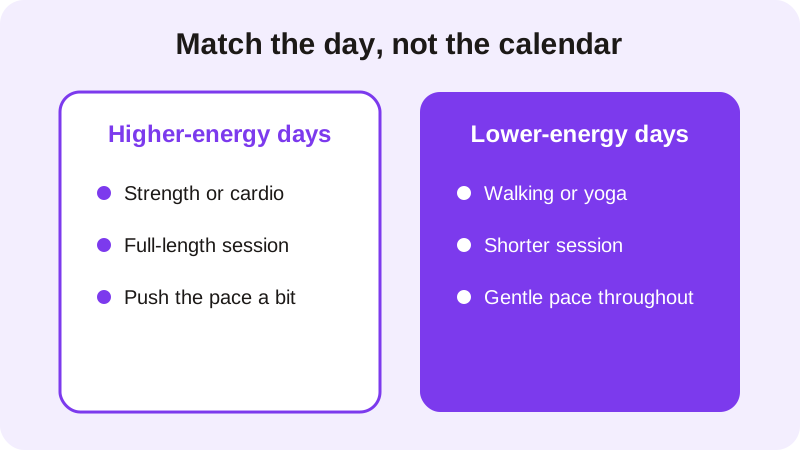
If you don't track your cycle closely, this is hard to plan around in advance. The PCOS Pal app's cycle-synced workouts are built for exactly this — suggesting gentler sessions on lower-energy days and saving the harder ones for when you have more to give, without you having to work it out yourself each time.
Gentler options are still real exercise, not a consolation prize. PCOS yoga for beginners and PCOS Pilates are both useful on days when a full session feels like too much — they still count toward the week's mix of movement.
What if structured exercise isn't realistic right now?
Then start with the most boring possible version: walking, done regularly, is still exercise, and it's where most people should actually start.
Stack movement onto something you already do rather than inventing a new block of time: a walk while a call is on, two flights of stairs instead of the lift, a lap of the garden before sitting down in the evening. None of it needs kit, a plan, or a tracked number of minutes to count. Once that's a habit, adding one or two short strength sessions — bodyweight squats, a resistance band, a set of stairs done slowly — is a smaller step than starting from nothing.
How do you know if you're overdoing it?
Exercise can be overdone with PCOS just as it can with any condition. More is not automatically better, and the body usually signals it before anything goes seriously wrong.
Exercise and food work together rather than as two separate projects — the PCOS diet guide covers the food side of the same insulin story this page has been describing from the movement side.
Sources
Frequently asked questions
How many days a week should I exercise with PCOS?
There's no official PCOS exercise guideline prescribing an exact number of days. A practical pattern is some easy movement on most days, strength training a few times a week, and at least one full rest day — adjusted to your energy rather than forced to a schedule.
Is cardio or strength training better for PCOS?
The cardio vs strength PCOS question isn't really either/or. Both help, and neither cancels the need for the other. Strength training gets particular attention because muscle plays a direct role in how the body handles glucose, which matters with insulin resistance.
Can you over-exercise with PCOS?
Yes. More is not automatically better. Constant exhaustion, new or worsening cycle irregularity, or workouts that leave you more anxious than steady are signs to scale back and talk to a doctor or dietitian who knows your history, rather than reasons to push harder.
Should I change my workout depending on my cycle?
Many people find it easier to match intensity to energy than to force a fixed plan through a low-energy week. Gentler sessions on harder days and more demanding ones when energy allows tends to be more sustainable than an unchanging schedule.
Do rest days matter with PCOS?
Rest days with PCOS matter as much as the active sessions. Recovery is where the body adapts to strength work, and skipping it in favour of back-to-back hard sessions tends to backfire into exhaustion rather than progress.
This article is for education. It is not medical advice, diagnosis or treatment — talk to a clinician about your own care.
More in this series
- Anti-inflammatory eating for PCOS: what is real — Where "anti-inflammatory" and PCOS actually meet, which foods the evidence supports, which only marketing does, and how it overlaps with insulin advice.
- Foods to limit with PCOS, and why banning them backfires — The foods worth eating less often with PCOS, the evidence for each, and why "limit" beats "never" for a diet you can keep.
- Insulin resistance and PCOS, explained — What insulin resistance is, why it is so common in PCOS, how it is actually tested, and what food, movement, sleep and medication each do about it.
- Low-GI foods for PCOS: a practical list — What the glycaemic index does and does not tell you, which carbohydrates rank low, how protein and fat change the picture, and where GI stops helping.
- PCOS breakfast ideas that hold you until lunch — Why breakfast is where PCOS eating plans break, the protein-fibre-fat template that fixes it, ten breakfasts that use it, and what to do about coffee.
- PCOS diet: what to eat, and why it works — What the evidence says about eating with PCOS: insulin, the pattern that helps, the foods worth limiting, and why no rigid plan is required.
- PCOS is now PMOS: what changed and what didn't — PCOS has a new name, polyendocrine metabolic ovarian syndrome. Why it changed, and why your diagnosis and treatment stay the same.
- A 7-day PCOS meal plan you can actually keep — Seven days of ordinary meals built on the pattern the evidence supports, with a shopping list and swaps, and no food group cut out.