A plain-language guide to the dark, velvety skin patches common with PCOS, why insulin resistance causes them, and what actually helps.
Published
Quick answer
PCOS dark patches on skin, usually on the neck, underarms or groin, are a common sign called acanthosis nigricans, linked to insulin resistance rather than hygiene. They can fade gradually as blood sugar steadies, but have any new or changing patch checked by a doctor.
Key takeaways
- Dark, velvety skin patches (acanthosis nigricans) often show up on the neck, underarms, groin or knuckles with PCOS.
- They're caused by high insulin acting on the skin, not poor hygiene — scrubbing won't remove them.
- Protein, fibre and low-GI carbs are the main lever for fading them gradually over time.
- Acne and hair thinning are other skin and hair changes often linked to the same insulin and androgen pattern.
- A new, fast-changing or unusual patch is worth a doctor's look to rule out other causes.
The dark, velvety patches of skin many people with PCOS notice on the back of the neck, underarms or knuckles are usually the skin's own reaction to high circulating insulin, not something that needs scrubbing or bleaching away. They're not dangerous on their own, but they're one of the more visible clues that it's worth looking closely at insulin and blood sugar.
What are the dark patches on skin with PCOS?
These patches are usually a skin change called acanthosis nigricans: skin that looks darker and thicker, with a velvety texture, most often across the back of the neck, in the armpits, under the breasts, in the groin crease or over the knuckles.
It isn't dirt and it isn't an infection — the texture change happens inside the skin's own cells, which is why no amount of washing moves it. Acanthosis nigricans isn't exclusive to PCOS; it shows up anywhere insulin resistance is present, and PCOS happens to be one of the more common reasons a woman develops insulin resistance in the first place. For some people it appears gradually, sometimes years before a cycle problem gets anyone looking at PCOS at all.
A doctor usually recognises it by sight rather than by a specific test, because the look and the location are fairly distinctive. That doesn't make it a diagnosis of PCOS on its own — plenty of people develop acanthosis nigricans from insulin resistance linked to body weight, certain medications or, more rarely, other conditions, with no PCOS involved at all. If you've noticed a new patch, it's a reasonable thing to raise at your next appointment rather than something to work out alone.
Insulin resistance and androgens: two drivers, one effect
Two overlapping hormone patterns sit behind most of the skin and hair changes that come with PCOS: insulin resistance and raised androgens. The insulin resistance and PCOS guide covers the mechanism in detail, but the short version is enough to explain the skin: when cells resist insulin's normal signal, the body compensates by releasing more of it, and that excess insulin acts on skin cells directly, prompting them to multiply and darken.
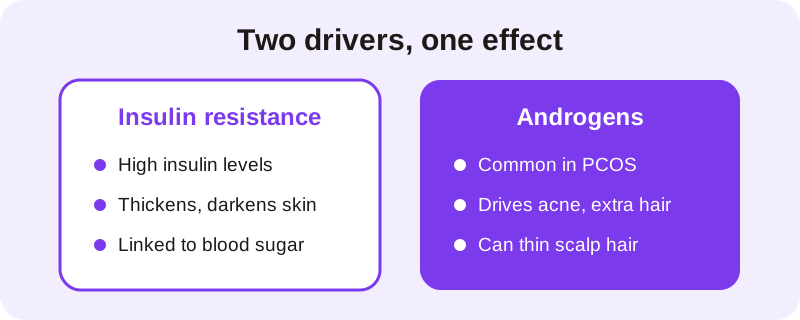
- Insulin resistance — High insulin levels. Thickens, darkens skin. Linked to blood sugar.
- Androgens — Common in PCOS. Drives acne, extra hair. Can thin scalp hair.
The two don't always move together. Someone can have noticeable insulin resistance with very little acne, or raised androgens with no visible skin darkening at all — PCOS looks different from one person to the next, which the PCOS is now PMOS piece touches on when it explains how variable the condition is.
Can diet help fade the patches?
There's no guarantee that changing what you eat will erase a patch, but the same approach that helps manage insulin resistance is the most reasonable place to start: a plate built around protein, fibre and a little fat, with low-GI carbohydrates standing in for refined ones.
The PCOS diet guide explains why this combination works: protein and fibre both slow down how quickly glucose enters the bloodstream, so less insulin is needed to clear it afterwards. The low-GI foods for PCOS list is a practical starting point for swapping white bread, white rice and sugary cereals for options that release their carbohydrate more slowly. None of this is a special diet built around the patches — it's the same ordinary eating pattern that helps with insulin resistance generally, and the 2023 international guideline is clear that no single diet composition beats another for PCOS; what matters is consistency.
Weight isn't the target here, and nothing about this approach promises it will move. Weight tends to shift, if it does, as a side effect of steadier eating and more regular movement over a long stretch of time — not the other way round. The same is true of the patches: any fading tends to be slow and gradual, tracking with how consistently blood sugar stays steadier, rather than something that responds to a single change in a single week.
Caring for the skin, and other signs that travel with it
Day to day, the patch itself needs very little beyond what any skin benefits from: gentle cleansing, regular moisturiser, and being left alone. Trying to speed things along with harsh products usually backfires.
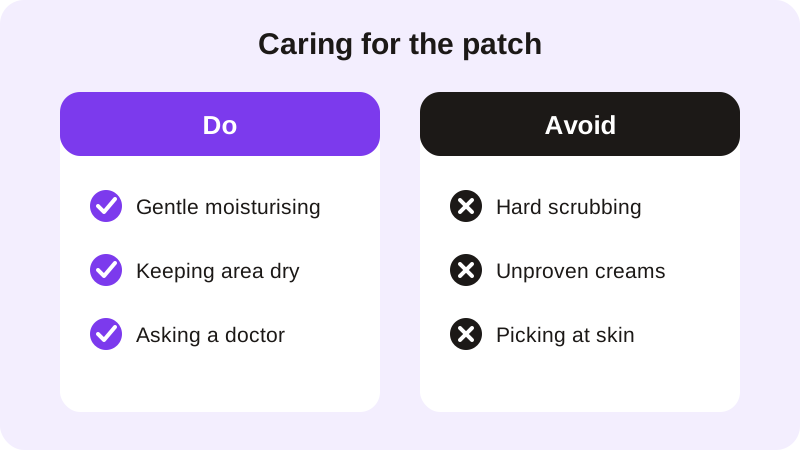
- Do — Gentle moisturising. Keeping area dry. Asking a doctor.
- Avoid — Hard scrubbing. Unproven creams. Picking at skin.
Acne and hair loss are two of the other visible signs that often travel alongside the patches, since both sit in the same insulin and androgen pattern described above. The PCOS Pal app tracks nine fixed symptoms, including acne, fatigue and bloating, and its doctor summary pulls that history together into something you can hand over — useful if you're asking a clinician about any of these skin or hair changes.
When to see a doctor about skin changes
Mention new or changing dark patches at the same appointment where you'd raise an irregular cycle or any other PCOS symptom — insulin resistance tends to connect all of these, so a clinician looking at one will usually want the full picture. They can also check for other causes of skin darkening, since conditions beyond PCOS can produce a similar pattern, and can talk through whether addressing insulin resistance directly, through food, movement or other options a clinician decides fit, makes sense for you.
None of this needs to be figured out alone. Tracking what you're noticing — where a patch is, whether it's changing, what else shows up alongside it — gives a clinician something concrete to work from, rather than a vague sense that something's different.
Sources
Frequently asked questions
Do dark patches on the skin always mean PCOS?
No. Acanthosis nigricans — the name for these patches — can appear with insulin resistance from several causes, including weight-related insulin resistance, certain medications, or other hormonal conditions, not only PCOS. Either way, the next step is the same: have a doctor look at it and ask about insulin resistance generally.
Can dark patches appear before any other PCOS symptoms show up?
Yes, that happens. Insulin resistance can develop before cycles become noticeably irregular or other signs appear, so a dark patch is sometimes the first visible clue. It doesn't confirm PCOS on its own, but it's a reasonable prompt to mention cycle patterns and request a broader check with a doctor.
Will losing weight make the patches disappear?
There's no guarantee either way. Patches sometimes lighten gradually as insulin resistance improves through steadier eating and regular movement, but weight itself is a lagging indicator of those habits, not a target to chase. A doctor or dietitian can help set expectations that fit your own situation.
Are skin-lightening creams safe to use on these patches?
That depends on the product and your own skin, so it's a question for a doctor or dermatologist rather than a guess from an article. Since the colour change sits in deeper skin layers and reflects insulin resistance, lightening the surface alone doesn't address what's causing it underneath.
This article is for education. It is not medical advice, diagnosis or treatment — talk to a clinician about your own care.
More in this series
- Anti-inflammatory eating for PCOS: what is real — Where "anti-inflammatory" and PCOS actually meet, which foods the evidence supports, which only marketing does, and how it overlaps with insulin advice.
- Foods to limit with PCOS, and why banning them backfires — The foods worth eating less often with PCOS, the evidence for each, and why "limit" beats "never" for a diet you can keep.
- Insulin resistance and PCOS, explained — What insulin resistance is, why it is so common in PCOS, how it is actually tested, and what food, movement, sleep and medication each do about it.
- Low-GI foods for PCOS: a practical list — What the glycaemic index does and does not tell you, which carbohydrates rank low, how protein and fat change the picture, and where GI stops helping.
- PCOS breakfast ideas that hold you until lunch — Why breakfast is where PCOS eating plans break, the protein-fibre-fat template that fixes it, ten breakfasts that use it, and what to do about coffee.
- PCOS diet: what to eat, and why it works — What the evidence says about eating with PCOS: insulin, the pattern that helps, the foods worth limiting, and why no rigid plan is required.
- PCOS is now PMOS: what changed and what didn't — PCOS has a new name, polyendocrine metabolic ovarian syndrome. Why it changed, and why your diagnosis and treatment stay the same.
- A 7-day PCOS meal plan you can actually keep — Seven days of ordinary meals built on the pattern the evidence supports, with a shopping list and swaps, and no food group cut out.