Explains how cortisol links stress to the glucose, insulin and androgen chain already at work in PCOS, and what eases that load day to day.
Published
Quick answer
PCOS stress and cortisol connect through blood glucose: cortisol raises glucose, which raises insulin, and insulin is tied to the androgens behind many PCOS symptoms. Steady meals, regular sleep and movement you can keep up ease that chain more than any quick fix.
Key takeaways
- Cortisol raises blood glucose, which raises insulin demand and feeds the androgens linked to PCOS symptoms.
- No exercise type is shown to work better than another for PCOS, per the 2023 international guideline.
- Protein, fibre and a little fat at meals blunts the glucose swings stress can worsen.
- Fatigue, low mood, poor sleep and headache overlap with stress and PCOS alike — track the pattern.
- Persistent stress, lost cycles or worsening symptoms are worth a doctor's visit, not guesswork.
PCOS and stress intersect at cortisol: the hormone your body releases under pressure feeds into the same glucose-insulin-androgen chain already at work with PCOS, which is why a rough stretch at work can show up as heavier cravings, worse skin or a cycle that goes quiet.
Does stress make PCOS worse?
Yes — cortisol pushes blood glucose up, and with PCOS already prone to insulin resistance, that extra glucose asks for more insulin, which is one of the drivers behind the higher androgens seen in PCOS.
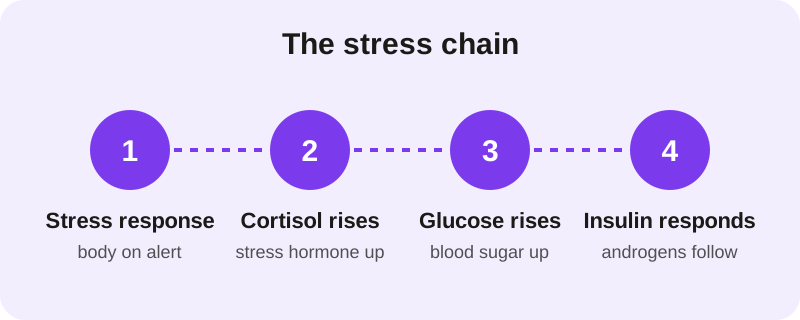
- Stress response — body on alert
- Cortisol rises — stress hormone up
- Glucose rises — blood sugar up
- Insulin responds — androgens follow
This is not a case of stress causing PCOS. The 2023 international guideline describes insulin resistance and androgens as core features of PCOS itself, present whatever triggered the diagnosis. What stress adds is pressure on a system that's already working harder than it should: a cortisol spike on top of existing insulin resistance means glucose takes longer to settle, which means insulin stays elevated for longer too. That chain is explained in more detail in insulin resistance and PCOS, and it is the reason stress and insulin resistance in PCOS tend to show up together rather than as two separate problems.
None of this means a diet or supplement will lower cortisol directly — nothing is shown to do that specifically. It does mean the everyday habits that buffer blood glucose do double duty: regular meals built around protein, fibre and a little fat help with insulin resistance and take some of the edge off a stressful day at the same time.
What PCOS-related stress feels like
Stress and PCOS share a lot of the same symptoms, which is part of why it's hard to tell what's driving what: fatigue, bloating, cramps, cravings and acne show up with both, and so do hair loss, low mood, poor sleep and headache.
- Fatigue that doesn't lift over a weekend off
- Cravings that spike in the afternoon or late at night
- Low mood or a short fuse that doesn't match the day
- Poor sleep, or sleep that doesn't feel restorative
- Headaches that cluster around a particular week
That overlap is exactly why tracking matters more than guessing: the PCOS Pal app logs these nine fixed symptoms alongside cycle length, which helps because PCOS cycles rarely run on a predictable schedule — a symptom that looks random day to day can turn out to cluster around a particular stretch once it's been logged for a few cycles. The app turns that log into a doctor summary, so a pattern you've noticed arrives backed by a record rather than memory.
What helps lower the stress load day to day?
Steady meals built around protein, fibre and a little fat blunt the glucose swings stress can worsen; regular sleep and wake times help the body recover overnight; and any movement you'll actually repeat works, since the 2023 international guideline finds no exercise type shown to be better than another for PCOS.
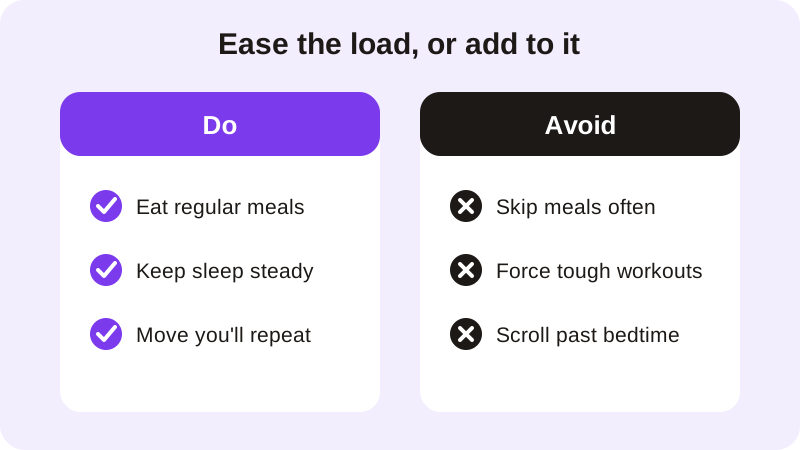
Do:
- Eat regular meals
- Keep sleep steady
- Move you'll repeat
Avoid:
- Skip meals often
- Force tough workouts
- Scroll past bedtime
On the exercise side, the guideline's numbers give a frame rather than a target to hit perfectly: 150 to 300 minutes of moderate activity a week, or 75 to 150 minutes of vigorous activity, plus muscle strengthening on two non-consecutive days a week. If weight loss is also a goal, the guideline points to 250 minutes of moderate activity a week. None of that has to happen in a gym — walking counts, and PCOS HIIT or walking and PCOS yoga for beginners both walk through realistic starting points. That's the core of managing stress with PCOS day to day: ease the chain with habits you can repeat, rather than trying to fight cortisol head-on.
Food timing matters too. Going long stretches without eating when things are stressful, then eating fast at the end of the day, is its own pattern — PCOS late night eating and PCOS sugar cravings both cover why that happens and what a steadier version of the day looks like. A full week of structured meals, rather than deciding at every mealtime, also takes decision-making off the table on days when that's the last thing you have energy for; the 7-day PCOS meal plan is built for exactly that.
When to loop in a doctor
Bring it to a doctor, registered dietitian or other clinician if stress feels constant rather than occasional, if cycles stop or change pattern for several months, if low mood or poor sleep doesn't lift, or if cravings and fatigue are affecting daily life — these are worth a conversation rather than something to manage alone.
A clinician who knows your history is also the right person to decide whether any testing, medicine or supplement fits your situation. Logging symptoms and cycles in the run-up to that appointment — what the app's doctor summary is built for — tends to make that conversation more specific than trying to describe a stressful month from memory.
Sources
Frequently asked questions
Can high cortisol cause PCOS?
There isn't one single cause of PCOS, and cortisol alone hasn't been shown to cause it. What's established is that PCOS involves insulin resistance and androgens, and stress can intensify that same chain. If stress feels constant or out of proportion to what's going on, a doctor can help work out what's driving it.
Does cutting out caffeine lower cortisol with PCOS?
There's no cortisol-specific caffeine rule for PCOS — the research doesn't single one out. Coffee's effect on blood sugar and symptoms varies from person to person, so watch how you feel after it and adjust from there; the PCOS and coffee guide covers the detail.
Can stress delay ovulation or a period with PCOS?
Stress can shift timing in cycles that are already irregular with PCOS, since the same hormonal chain that responds to stress also plays into ovulation. A delayed or skipped cycle during a stressful stretch is common; tracking the pattern over several cycles, rather than judging a single month, gives the clearer picture.
Is cortisol testing part of diagnosing PCOS?
Cortisol isn't one of the standard checks used to look at PCOS. Diagnosis rests on criteria a clinician applies to your cycles, symptoms and sometimes bloodwork or a scan. If stress or cortisol levels are a specific worry, raise that separately with a doctor who can decide whether testing makes sense.
This article is for education. It is not medical advice, diagnosis or treatment — talk to a clinician about your own care.
More in this series
- Anti-inflammatory eating for PCOS: what is real — Where "anti-inflammatory" and PCOS actually meet, which foods the evidence supports, which only marketing does, and how it overlaps with insulin advice.
- Foods to limit with PCOS, and why banning them backfires — The foods worth eating less often with PCOS, the evidence for each, and why "limit" beats "never" for a diet you can keep.
- Insulin resistance and PCOS, explained — What insulin resistance is, why it is so common in PCOS, how it is actually tested, and what food, movement, sleep and medication each do about it.
- Low-GI foods for PCOS: a practical list — What the glycaemic index does and does not tell you, which carbohydrates rank low, how protein and fat change the picture, and where GI stops helping.
- PCOS breakfast ideas that hold you until lunch — Why breakfast is where PCOS eating plans break, the protein-fibre-fat template that fixes it, ten breakfasts that use it, and what to do about coffee.
- PCOS diet: what to eat, and why it works — What the evidence says about eating with PCOS: insulin, the pattern that helps, the foods worth limiting, and why no rigid plan is required.
- PCOS is now PMOS: what changed and what didn't — PCOS has a new name, polyendocrine metabolic ovarian syndrome. Why it changed, and why your diagnosis and treatment stay the same.
- A 7-day PCOS meal plan you can actually keep — Seven days of ordinary meals built on the pattern the evidence supports, with a shopping list and swaps, and no food group cut out.