PCOS Pal is a free app that tracks irregular cycles, scores food by protein, carbohydrate and glycaemic index, and matches workouts to your cycle phase.
PCOS Pal is a free app that tracks irregular cycles, scores food by its protein, carbohydrate and glycaemic index, and matches workouts to where you are in your cycle. It is built for the day-to-day work of living with PCOS, not for a diet plan you follow for a few weeks and abandon.
Between 10 and 13% of women worldwide have PCOS, and roughly 1 in 10 women of reproductive age have it — common enough that most people managing it are doing so with very little support between appointments. This page walks through what is actually inside the app, and how each part connects to the everyday questions covered elsewhere on this site.
What does PCOS Pal actually track?
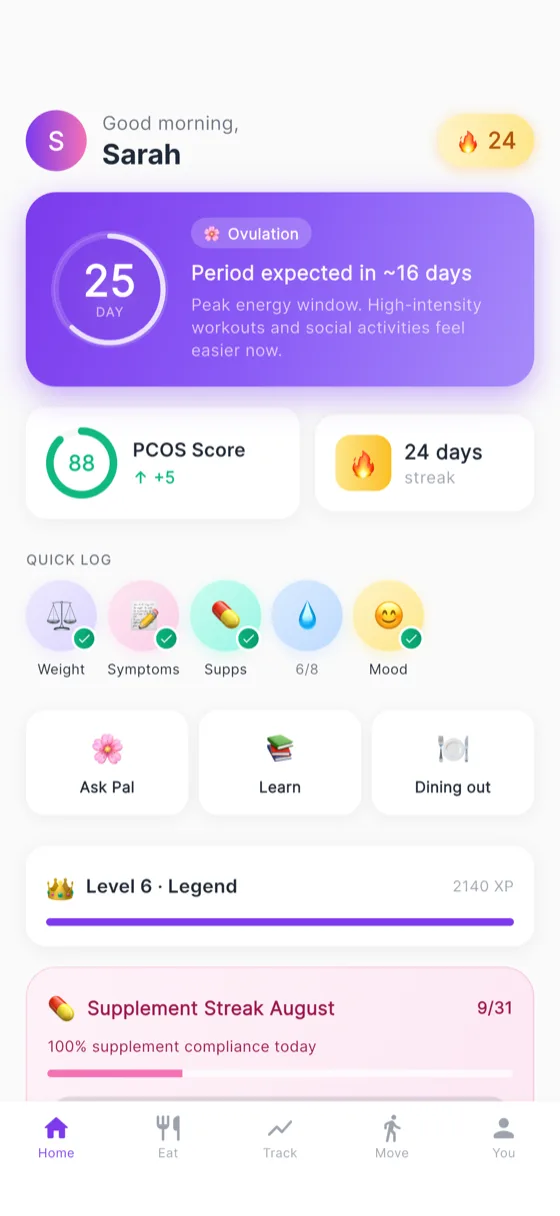
The core of the app is cycle tracking built for irregularity, not for a textbook 28-day cycle. PCOS itself makes cycles unpredictable, so a tracker that expects regularity is not much use. Alongside cycle length, the app logs symptoms over time, which matters because PCOS symptoms — skin, mood, energy, appetite — tend to shift across a cycle rather than sitting still.
That log becomes the doctor summary: a way to bring a clinician an actual record instead of trying to remember, in a ten-minute appointment, what happened over the last three months. It does not diagnose anything. It hands a clinician the pattern so they can do the assessing.
How does the food scoring work?
Every food gets a PCOS score built from its protein and carbohydrate content and, where the value is known, its glycaemic index. Diabetes UK's own bands sit behind that: a GI of 55 or below is low, 56 to 69 is medium, and 70 or more is high. The app is not inventing a new rule here — it is applying the same glycaemic load thinking covered in the low-GI foods for PCOS guide, just automated so you are not doing the lookup yourself.
The barcode scanner is the practical version of that: scan a packet in a shop or your kitchen and get the score without typing anything in. It is a comparison tool between two similar foods, not a verdict on whether a food is allowed. Nothing in the 2023 international guideline supports banning food groups for PCOS — it finds no evidence that any one diet composition beats another — and the app's scoring follows the same logic laid out in the PCOS diet guide: protein, fibre and a little fat make a meal work harder, whatever the meal is.
The seven-day meal rotation takes that further, giving you a week's worth of meals built on the same template so you are not rebuilding a plan from scratch every Sunday. It works alongside the ideas in the 7-day PCOS meal plan, and pulls from the same territory as the app's breakfast and snack suggestions, which echo the reasoning in PCOS breakfast ideas and PCOS snacks.
Why does the app link food, cycles and workouts together?
Because they are not separate problems. Insulin resistance is the mechanism most often behind PCOS: food raises glucose, glucose raises insulin, and in someone insulin-resistant, that pushes insulin higher than it needs to be, which in turn can raise androgens. That chain is explained properly in insulin resistance and PCOS, explained, and it is also the reason insulin resistance carries a longer-term link to type 2 diabetes that the guideline flags as worth managing early, not just reacting to.
Cycle-synced workouts exist because energy and capacity are not flat across a cycle, and forcing the same workout intensity every day regardless of where you are is a good way to burn out on a plan. Matching movement to cycle phase is less about a rule and more about working with what your body is already doing, rather than against it.
Ask Pal sits across all of this — a way to ask a question about a food, a symptom or a pattern in your log and get an answer shaped by what you have actually tracked, rather than a generic search result.
Is PCOS Pal free, and does it work on Android?
Yes to both. The app is free to download, with no ads, and it is available on Google Play, so Android users get the same core features as anyone else. Premium exists for people who want more — deeper history, more detailed reports — but the daily tools most people reach for first (cycle tracking, food scoring, the barcode scanner, workout matching) do not require paying anything.
That matters for a condition this common. With PCOS affecting somewhere between 10 and 13% of women worldwide, a tool that requires payment before it is useful shuts a lot of people out. Free access to the basics is the more useful design.
How does this fit with everything else on this site?
The app is one part of managing PCOS day to day; the rest is the eating, the cravings, the cycles of energy and appetite that come with it. If sugar cravings are the thing derailing you, PCOS sugar cravings explains the blood sugar swings behind them. If it is late-night eating specifically, PCOS late night eating covers why that pattern shows up. If you are wondering whether fasting, gluten, dairy, coffee or alcohol need to change, there are dedicated pages on each — intermittent fasting, gluten, dairy, coffee, and alcohol — none of which recommend cutting a food group out wholesale.
Fibre and hydration are the quieter levers: PCOS fibre intake and PCOS hydration cover what the evidence actually supports there, and both connect back to the Eatwell Guide's basic ask of at least five portions of fruit and veg a day, which does more for fibre and blood sugar steadiness than any single supplement or trend.
None of this — the app included — is about finding one correct diet. The NHS, Diabetes UK, ACOG and the 2023 international guideline all point the same way: no single diet composition works better than another for PCOS, and unduly restrictive eating tends to backfire, a point covered directly in foods to limit with PCOS. What actually helps is consistency — eating with enough protein and fibre, moving in a way that fits your energy, and having a record to bring to whoever is helping you manage it clinically. That is what the app is built to support.
Frequently asked questions
Is PCOS Pal free?
Yes. PCOS Pal is free to download and use, with no ads. A Premium tier exists for people who want more from the app, but the core tracking, food scoring and workout matching work without paying anything.
Is PCOS Pal available on Android?
PCOS Pal is available on Google Play, so it works on Android devices as well as other platforms. You download it the same way as any other app and set up your cycle and food tracking from there.
Does PCOS Pal replace seeing a doctor?
No. It is a tracking tool, not a diagnostic one. The doctor summary feature is built to make appointments more useful by bringing your logged cycles and symptoms with you, but decisions about diagnosis and treatment still belong to a clinician.
What is the PCOS score in the app?
It is a score PCOS Pal gives a food based on its protein and carbohydrate content and, where known, its glycaemic index. It is meant as a quick comparison between foods, not a strict rule about what you can or cannot eat.
Does PCOS Pal tell me what type of PCOS I have?
No. The app does not diagnose or categorise PCOS. It tracks patterns in your cycles, symptoms and food so you have information to bring to a clinician, who is the one who can assess and diagnose.
Put this into practice with PCOS Pal. The free app scores every food by its protein, carbohydrate and glycaemic index, rotates a seven-day set of meals, and tracks a cycle that is not 28 days.
This article is for education. It is not medical advice, diagnosis or treatment — talk to a clinician about your own care.
More in this series
- Anti-inflammatory eating for PCOS: what is real — Where "anti-inflammatory" and PCOS actually meet, which foods the evidence supports, which only marketing does, and how it overlaps with insulin advice.
- Foods to limit with PCOS, and why banning them backfires — The foods worth eating less often with PCOS, the evidence for each, and why "limit" beats "never" for a diet you can keep.
- Insulin resistance and PCOS, explained — What insulin resistance is, why it is so common in PCOS, how it is actually tested, and what food, movement, sleep and medication each do about it.
- Low-GI foods for PCOS: a practical list — What the glycaemic index does and does not tell you, which carbohydrates rank low, how protein and fat change the picture, and where GI stops helping.
- PCOS breakfast ideas that hold you until lunch — Why breakfast is where PCOS eating plans break, the protein-fibre-fat template that fixes it, ten breakfasts that use it, and what to do about coffee.
- PCOS diet: what to eat, and why it works — What the evidence says about eating with PCOS: insulin, the pattern that helps, the foods worth limiting, and why no rigid plan is required.
- A 7-day PCOS meal plan you can actually keep — Seven days of ordinary meals built on the pattern the evidence supports, with a shopping list and swaps, and no food group cut out.