This article explains what is actually known about intermittent fasting for PCOS, who it may not suit, and what a steadier, protein-and-fibre approach looks like instead.
Intermittent fasting is not a required or recommended treatment for PCOS — the 2023 international guideline does not single it out, and finds no evidence that any one diet composition beats another. It can suit some people as a way of structuring meals, but it is not a fix for insulin resistance, and it does not suit everyone.
This sits under the same reasoning as the PCOS diet guide: insulin is the lever in PCOS, and how you eat matters more than a label like "fasting" or "keto". Roughly 1 in 10 women of reproductive age have PCOS, and between 10 and 13% of women worldwide have it — a large, varied group, which is exactly why no single eating pattern is going to fit everyone in it.
What does intermittent fasting actually mean?
Intermittent fasting is not one thing. It usually means restricting eating to a window during the day — commonly eight hours, sometimes shorter — and not eating outside it, or eating normally most days with much lower intake on one or two days a week. Both versions change when you eat, not what you eat.
That distinction matters for PCOS. Insulin resistance, which the 2023 international guideline names as a factor in PCOS, is about how the body responds to glucose from food — not about the clock. Fasting windows can indirectly affect glucose and insulin by changing meal timing and total intake, but they are not a substitute for the food choices covered in insulin resistance and PCOS.
Does fasting help with insulin resistance in PCOS?
This is the honest gap: the evidence base specific to PCOS and fasting windows is thin, and the 2023 international guideline does not recommend fasting as a PCOS treatment. What it does recommend is healthy eating tailored to the individual, in line with general population guidance such as the Eatwell Guide, with no food group banned outright.
Where fasting sometimes helps is indirectly. If a long eating window has meant grazing all day on high-GI snacks, narrowing it can reduce total intake and reduce the number of glucose spikes. But the same result — steadier blood sugar, less insulin demand — comes from choosing foods with protein, fibre and a little fat at regular times, without needing to skip meals at all. Diabetes UK's glycaemic index framework is a more direct tool here: a food scoring 55 or below is low GI, 56 to 69 is medium, and 70 or more is high, and combining a high-GI food with protein or fibre slows the rise. That is covered in detail in low-GI foods for PCOS.
Glycaemic load — which factors in portion size as well as speed — usually matters more than either GI or fasting windows alone. A small plate of rice and a large one behave very differently, whatever time you eat them.
Who should be cautious with intermittent fasting?
A few groups are worth flagging, not as a blanket "don't" but as a reason to talk to a clinician first.
- Anyone with a history of disordered eating. Structured restriction, even framed around timing rather than food type, can be a difficult pattern to sit inside.
- Anyone trying to conceive, or pregnant. ACOG and other bodies have specific guidance on nutrition around conception and pregnancy, and fasting protocols are not something to start without checking they fit your situation.
- Anyone on medicine that affects blood sugar. Skipping meals changes how some medicines behave. This is a conversation for a doctor or pharmacist, not a guess.
- Anyone who finds long gaps trigger overeating later. If an eight-hour window means intense hunger followed by eating past comfortable fullness, the pattern is working against you, not for you.
None of this means fasting is unsafe for everyone. It means it is a personal fit question, the same way any eating pattern is — which is exactly what the 2023 international guideline's "tailored to the individual" language is getting at.
What tends to work better day to day
For most people with PCOS, the more reliably useful habit is not a fasting window but a rhythm: regular meals built around protein, fibre and a little fat, spaced so blood sugar does not swing between empty and full. That is the template behind the PCOS breakfast ideas and the 7-day PCOS meal plan.
If you do want to try a shorter eating window, a few practical adjustments make it easier to sustain:
- Break the fast with protein and fibre — eggs, yoghurt, beans, fish with vegetables — rather than something high-GI on an empty stomach, which tends to produce a sharper glucose and insulin response.
- Keep at least five portions of fruit and veg a day inside the window; a shorter window is not a reason to drop vegetables.
- Watch for late-night eating creeping back in as compensation for a skipped breakfast — PCOS late night eating covers why that pattern shows up and what helps.
- If sugar cravings intensify on a fasting schedule, that is worth noticing rather than pushing through — see PCOS sugar cravings for why they happen.
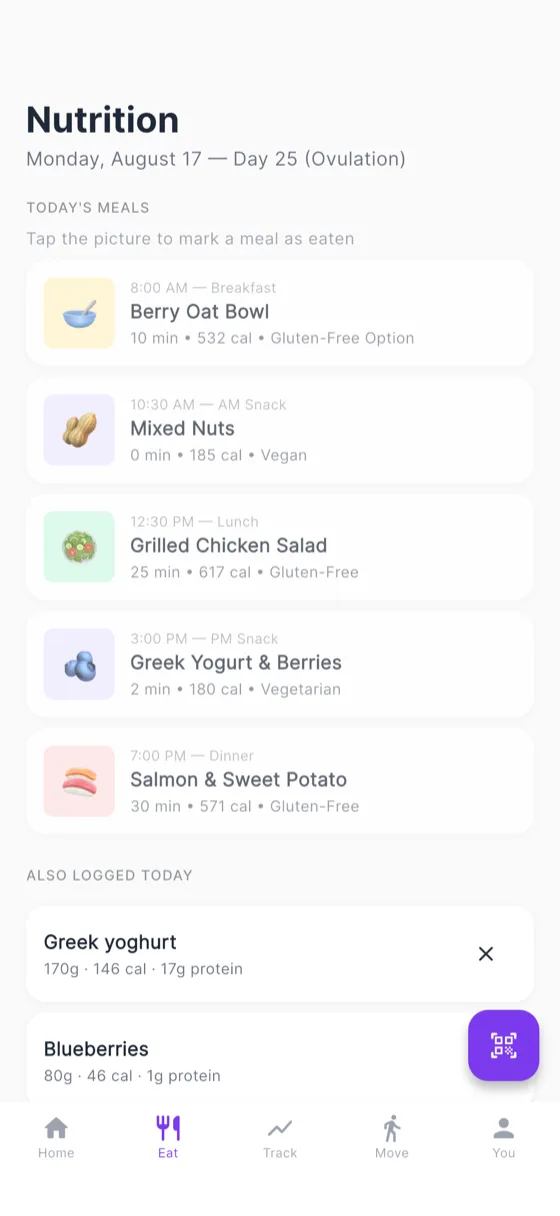
If planning meals around a window feels like a lot to track manually, the PCOS Pal app's seven-day meal rotation and PCOS score can take some of that load off, scoring foods by protein, carbohydrate and glycaemic index and rotating meals so you are not rebuilding a plan from scratch every day.
What about anti-inflammatory claims tied to fasting?
Fasting is sometimes marketed alongside anti-inflammatory eating, as though the two always go together. They do not automatically. Whether a fasting window reduces inflammation markers in PCOS specifically is not something the current guideline addresses, and claims along those lines are worth reading skeptically. What is better supported is the food-quality side of anti-inflammatory eating — more vegetables, fibre and unsaturated fat, less ultra-processed food — which is covered separately in anti-inflammatory eating for PCOS, and which does not require a fasting window to apply.
The same goes for foods people cut out to "fit" a fasting protocol. Restriction for its own sake tends to backfire, which is the whole argument in foods to limit with PCOS: limiting beats banning, and no food group needs to disappear entirely to manage insulin and androgens.
The practical takeaway
Intermittent fasting is neither a PCOS treatment nor something to avoid outright. It is one way some people structure their eating, and for some it fits well; for others, particularly anyone with a history of restrictive eating or who is trying to conceive, it is worth discussing with a clinician first. The steadier, better-supported lever is what you eat and how it is balanced — protein, fibre and a little fat, regular meals, glycaemic load kept in mind — not when the clock says you are allowed to eat it.
Frequently asked questions
Does intermittent fasting cure PCOS?
No. The 2023 international guideline finds no evidence that any single diet composition, including fasting patterns, outperforms another for PCOS. Fasting does not balance hormones or reverse the condition — it is, at most, one way of structuring when you eat.
Is intermittent fasting safe with PCOS?
It depends on the person. Long gaps without food can trigger intense hunger and overeating later, and anyone with a history of disordered eating, or who is trying to conceive, should talk to a doctor or dietitian before restricting eating windows.
Will fasting help with insulin resistance in PCOS?
Fasting windows are not proven to work better than consistent, balanced meals for insulin resistance in PCOS. What is better supported is choosing foods with protein, fibre and a little fat at regular times, which keeps blood sugar steadier.
What should I eat when I break a fast?
Start with protein and fibre rather than something high-GI on an empty stomach, which can cause a sharper glucose and insulin spike. A meal built around eggs, yoghurt, beans or fish with vegetables is a steadier choice than toast or cereal alone.
Put this into practice with PCOS Pal. The free app scores every food by its protein, carbohydrate and glycaemic index, rotates a seven-day set of meals, and tracks a cycle that is not 28 days.
This article is for education. It is not medical advice, diagnosis or treatment — talk to a clinician about your own care.
More in this series
- Anti-inflammatory eating for PCOS: what is real — Where "anti-inflammatory" and PCOS actually meet, which foods the evidence supports, which only marketing does, and how it overlaps with insulin advice.
- Foods to limit with PCOS, and why banning them backfires — The foods worth eating less often with PCOS, the evidence for each, and why "limit" beats "never" for a diet you can keep.
- Insulin resistance and PCOS, explained — What insulin resistance is, why it is so common in PCOS, how it is actually tested, and what food, movement, sleep and medication each do about it.
- Low-GI foods for PCOS: a practical list — What the glycaemic index does and does not tell you, which carbohydrates rank low, how protein and fat change the picture, and where GI stops helping.
- PCOS breakfast ideas that hold you until lunch — Why breakfast is where PCOS eating plans break, the protein-fibre-fat template that fixes it, ten breakfasts that use it, and what to do about coffee.
- PCOS diet: what to eat, and why it works — What the evidence says about eating with PCOS: insulin, the pattern that helps, the foods worth limiting, and why no rigid plan is required.
- A 7-day PCOS meal plan you can actually keep — Seven days of ordinary meals built on the pattern the evidence supports, with a shopping list and swaps, and no food group cut out.